


Pardot dynamic lists are rule-based prospect lists that maintain themselves. You define criteria once – for example “Industry is Manufacturing and Score is greater than 50” – and Pardot automatically adds every prospect who matches and removes everyone who stops matching. No imports, no manual clean-up.
This article is part of our guide to Pardot segmentation.
This guide covers everything you need to work with dynamic lists in practice: how they differ from other Pardot list types, how to create one step by step, which criteria are available, where the limits are – and how to get around the biggest limitation of all: dynamic lists can only see a small part of your Salesforce data.
A note on naming: Salesforce renamed Pardot to Marketing Cloud Account Engagement (MCAE) in 2022. The product and its list features are the same. Since most admins and marketers still search for “Pardot”, we use both names in this article.
What are Pardot dynamic lists?
A dynamic list is a list in Pardot whose membership is controlled entirely by rules. Instead of adding prospects yourself, you describe who belongs on the list. Pardot evaluates every prospect against those rules and keeps the list up to date as prospect data changes – when a field is updated, a form is submitted, a score goes up or a record syncs from Salesforce.
That makes dynamic lists the backbone of most Pardot setups. You can use them as:
- Recipient lists for list emails and scheduled sends
- Recipient or suppression lists in Engagement Studio programs
- Suppression lists to exclude competitors, customers or unengaged prospects
- Segments for reporting, e.g. to see how many mailable prospects you have in a region
The trade-off: because the rules are in charge, you can’t manually add or remove a single prospect. If someone should be on the list, the data has to say so.
Pardot list types compared
Pardot has two fundamental list types – static and dynamic – plus several list settings that change how a list is used. Here is how they fit together:
| List type | How membership is managed | Typical use |
|---|---|---|
| Static list | Manually, by import, or by automation rules, completion actions and Engagement Studio. Members stay until someone removes them. | Event attendees, webinar registrants, one-off imports, “snapshot” audiences |
| Dynamic list | Automatically by rules. Prospects are added and removed as their data changes. | Ongoing segments: mailable prospects, customers, target accounts, regional lists |
| Test list | Manually; limited to a small group of internal recipients. | Sending test emails to colleagues before a send |
| Public list | Static or dynamic list that is shown on the email preference center. | Newsletter topics prospects can opt in to or out of |
| CRM-visible list | Static list that sales users can add prospects to from Salesforce. | Letting reps nominate contacts for a campaign or event |
| Suppression list | Any list used to exclude prospects from a send. | Excluding competitors, customers or recent recipients |
Two things are worth knowing up front:
- You choose static or dynamic when you create the list. You can later convert a dynamic list into a static one (or split it into static lists), but that cannot be undone, and a static list can never become dynamic.
- A dynamic list can be public. Prospects only see it in the preference center if they currently match its criteria.
How to create a dynamic list in Pardot
Creating a dynamic list takes a few minutes. The steps below use the Account Engagement Lightning app; menu names in older Pardot interfaces differ slightly.
- Open the list overview. In the Account Engagement app, go to Segmentation Lists (in older interfaces: Marketing → Segmentation → Lists).
- Click “+ Add List” and give the list a clear name, e.g.
DL – Mailable Customers – DACH. A naming prefix like “DL” makes dynamic lists easy to recognise later. - Tick “Dynamic List”. Optionally choose a folder, tags and – if prospects should see it in the preference center – Public List.
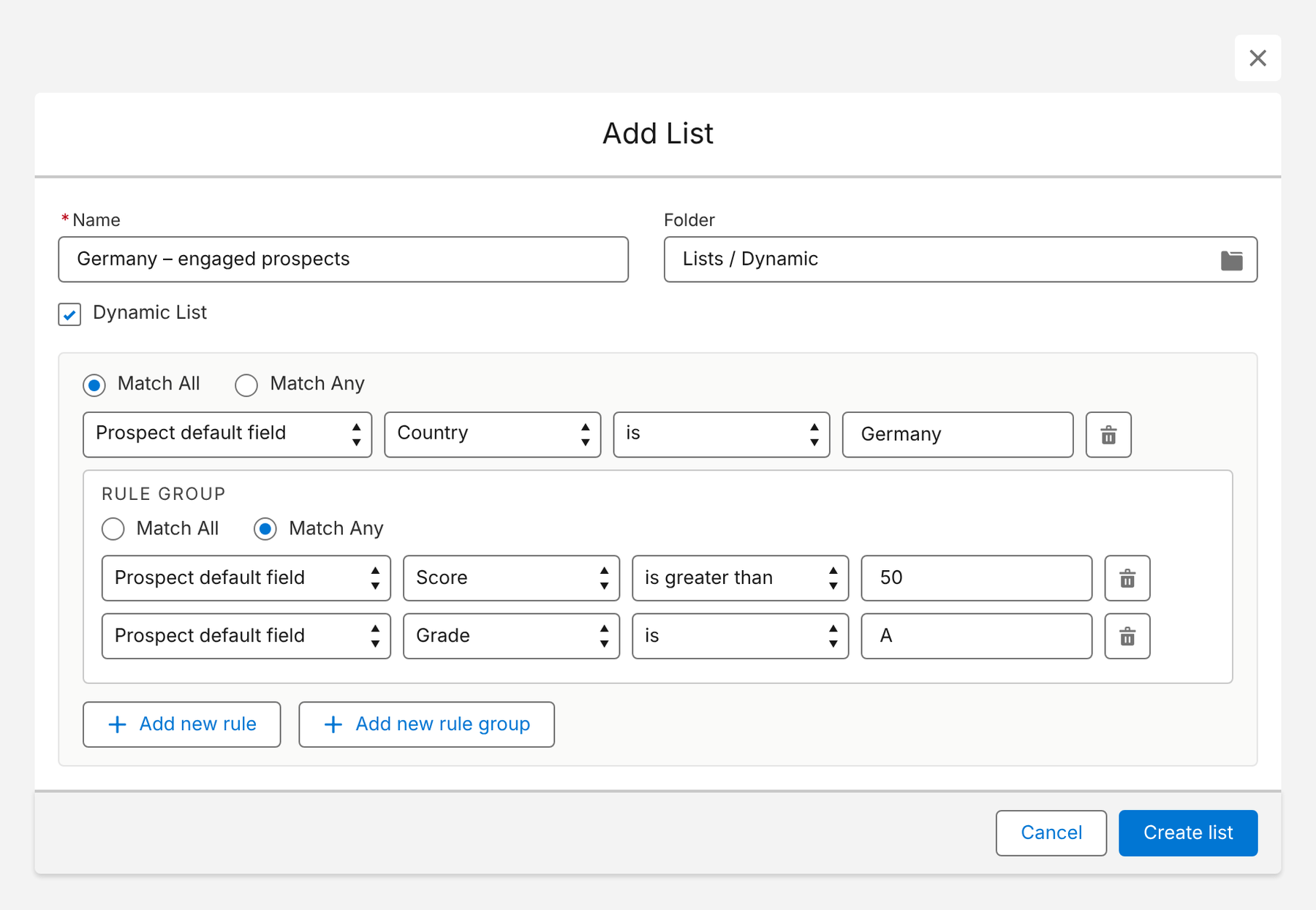
- Choose “Match All” or “Match Any”. Match All works like AND: a prospect has to meet every rule. Match Any works like OR: one matching rule is enough.
- Add your rules. Each rule consists of a criterion (e.g. Prospect default field → Country), an operator (is, contains, is greater than …) and a value.
- Use rule groups for complex logic. A rule group has its own Match All / Match Any setting, so you can build logic like “Country is Germany AND (Score > 50 OR Grade is A)”.
- Save the list. Pardot builds the list in the background. For large databases this can take a while – wait for the confirmation email before you use the list in a send.
Which criteria can you use?
Dynamic list rules can draw on everything Pardot knows about a prospect. The most common criteria are:
- Prospect default and custom fields – Country, Industry, Job Title, Lead Source, any custom field you sync from Salesforce
- Score and grade – e.g. “Score is greater than 100” or “Grade is A or B”
- Email status – opted out, Do Not Email, hard bounced; essential for “mailable” lists
- Activities – form submissions, page views, file downloads, emails received or clicked within a time frame
- List membership – “is / is not a member of list X”, useful to build lists on top of lists
- Tags and assignment – tagged prospects, assigned user or queue
- Salesforce account fields – e.g. Account Type, Account Industry, Annual Revenue
- Salesforce opportunity fields – e.g. Opportunity Stage, Amount, Close Date (only for prospects linked to an opportunity)
- Salesforce campaign membership – “Prospect is a member of Salesforce campaign X”, optionally with a specific campaign member status such as Registered or Attended
That last criterion is more powerful than it looks. As we’ll see below, it is the key to using any Salesforce data in your dynamic lists.
Limitations of Pardot dynamic lists
Dynamic lists are excellent for segmenting on prospect data. They start to hurt when your segmentation depends on what lives in Salesforce. These are the limits you will run into:
1. Pardot only sees a fraction of your Salesforce data. Out of the box, rules can use prospect, account and opportunity data. Cases, products, orders, contracts, assets, tasks, subscriptions and most custom objects are not available. Account Engagement’s custom object sync helps in higher editions, but it requires setup per object and only covers custom objects directly related to leads, contacts or accounts – nested objects can’t be synced at all.
2. Only existing prospects can be on a list. A dynamic list can only contain records that already exist as prospects in Pardot. A Salesforce lead or contact that was never synced will never show up – no matter how well it matches your rules. How you control which records get synced is covered in our guide to Pardot sync rules.
3. Account and opportunity rules only match linked prospects. Rules on opportunity fields only match prospects that are associated with that opportunity. Contacts without a contact role, for example, fall through the cracks – a common reason for counts that don’t match a Salesforce report.
4. No manual overrides. You can’t add a VIP contact to a dynamic list “just this once”. You either change the data or work with an additional static list.
5. Some changes don’t trigger a recalculation. Renaming a Salesforce campaign or changing other campaign fields doesn’t re-evaluate the list. Prospects keep their membership until their own record is updated.
6. Dynamic lists cost performance. Every dynamic list is continuously re-evaluated. Salesforce recommends staying below 1,000 dynamic lists and deleting or converting the ones you no longer need.
How to use any Salesforce data in a Pardot dynamic list
Limitation #1 is the one marketing teams feel most. The question is usually something like: “Can I email every contact whose account bought product X in the last 12 months and has no open support case?” Pardot alone can’t answer that.
The workaround uses the one Salesforce object that dynamic lists can read reliably: campaign members. If a Salesforce campaign contains exactly the right people, a dynamic list can simply mirror it. The challenge is keeping that campaign up to date automatically – and that’s what Campaign Audience Builder does natively in Salesforce.
The setup has three building blocks:
- a Salesforce campaign that acts as the container,
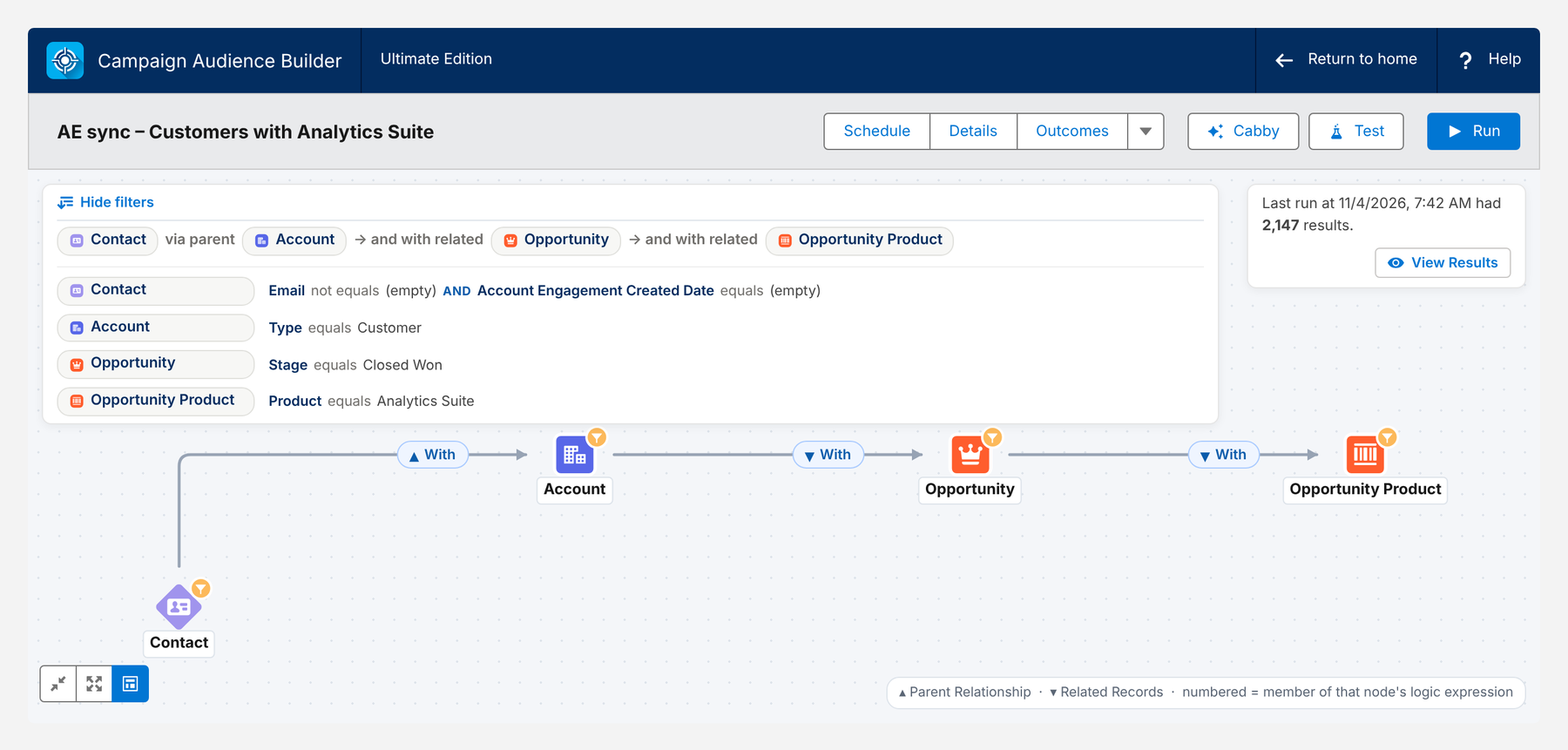
- an audience in Campaign Audience Builder with your criteria, which keeps the campaign members up to date on a schedule,
- a dynamic list in Pardot that pulls those campaign members.
Step 1: Create the Salesforce campaign
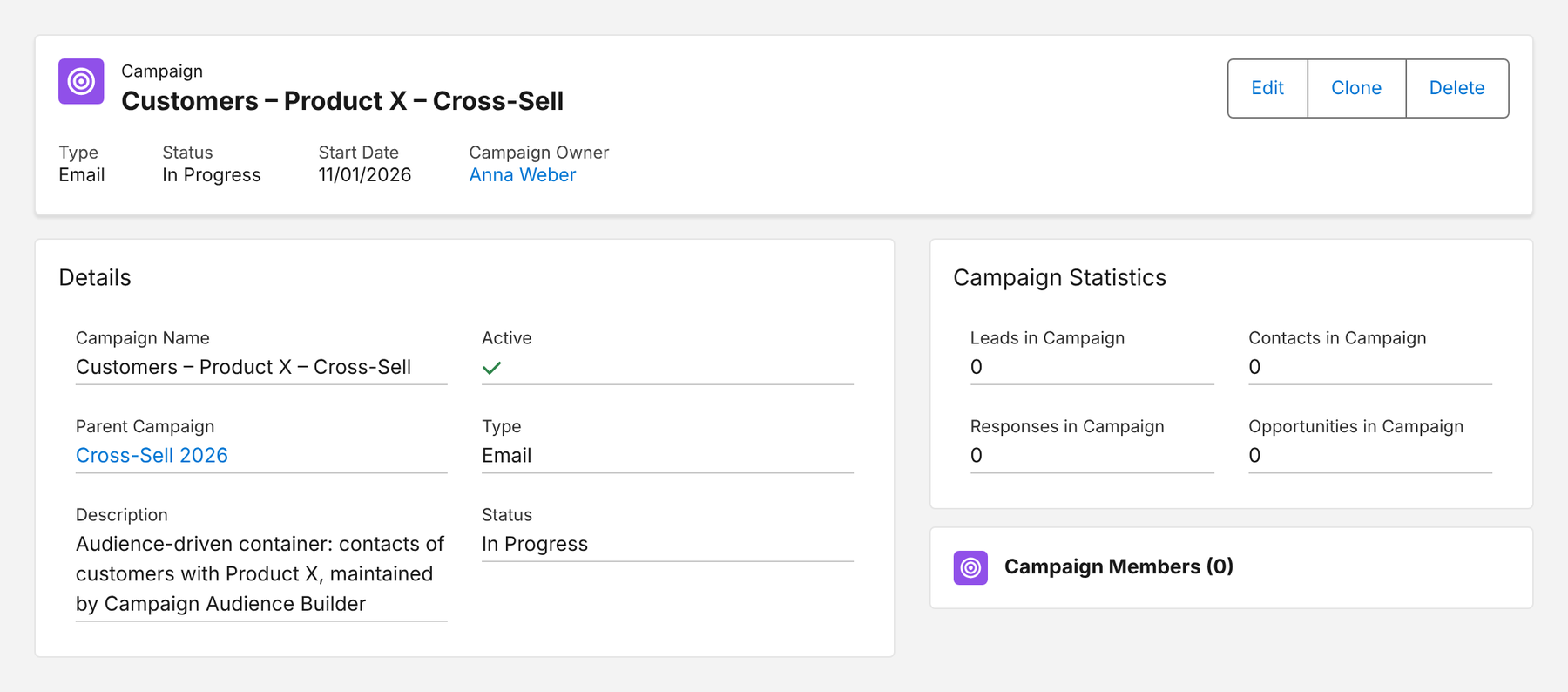
Create a regular Salesforce campaign for your target group, e.g. “Customers – Product X – Cross-Sell”. At this point it’s just an empty container. Make sure it’s available to the Pardot connector, so Account Engagement can see it.
Step 2: Build the audience with your criteria
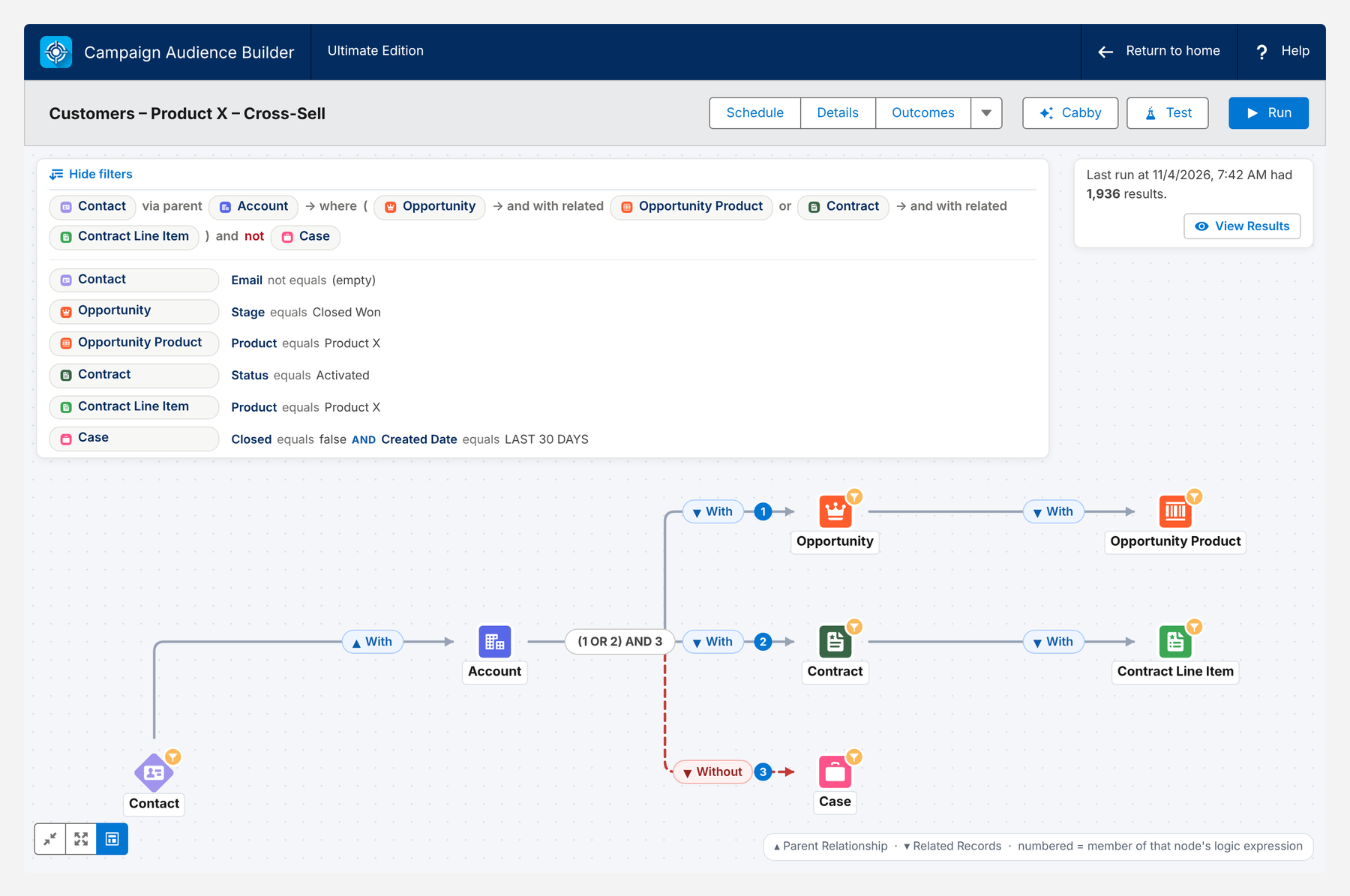
In Campaign Audience Builder, create a contact or lead audience and define the criteria – using any standard or custom object in your org. For example: contacts whose account has a Closed Won opportunity with product X, or an active contract with a specific line item, and no open case in the last 30 days. Filters can be nested across related objects without writing SOQL or building reports.
Step 3: Schedule the audience
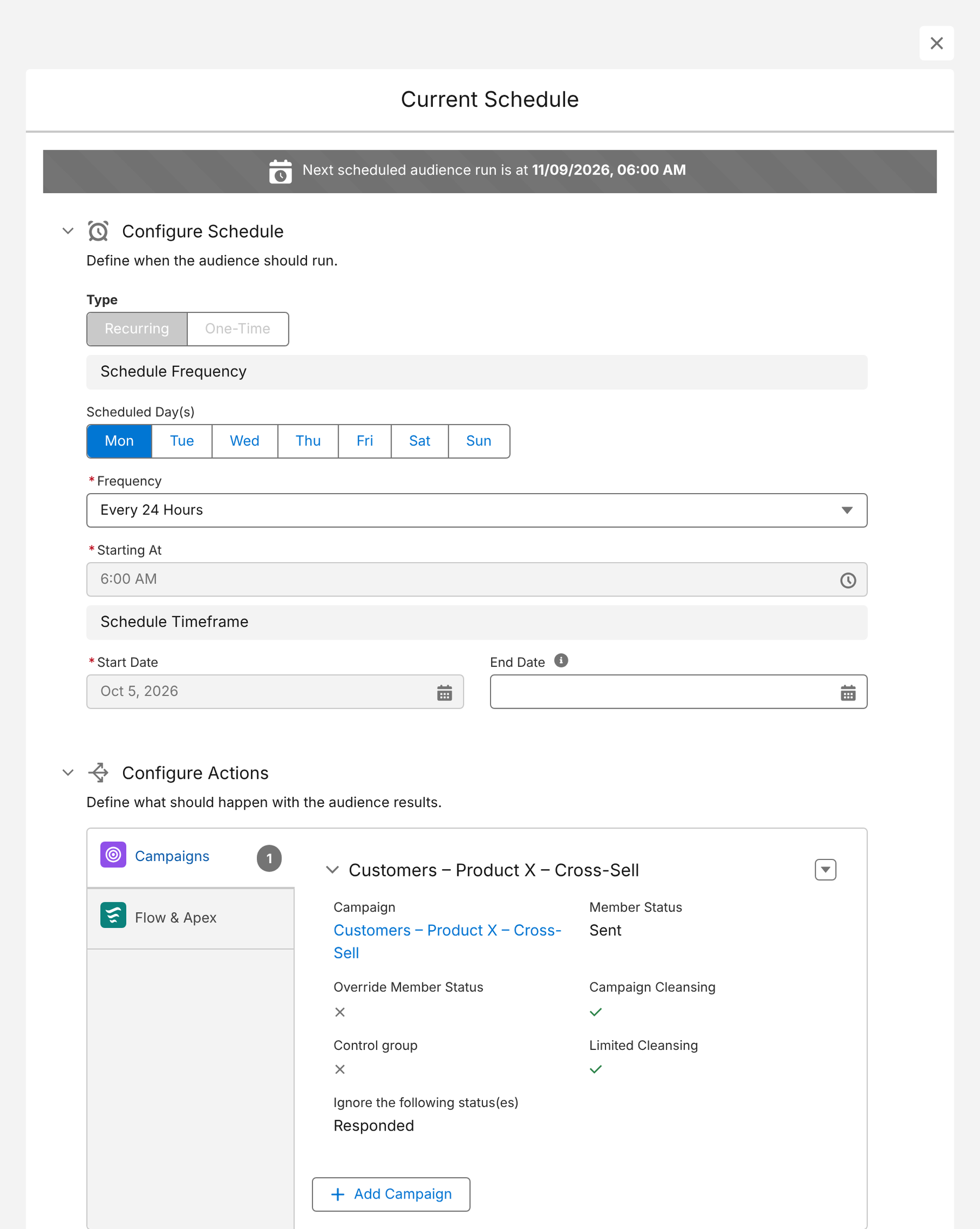
Link the audience to your campaign and set a schedule – daily or hourly, for example. On every run, Campaign Audience Builder adds new matching records as campaign members and removes those that no longer match. Your campaign now behaves like a dynamic list inside Salesforce.
Step 4: Create the dynamic list in Pardot
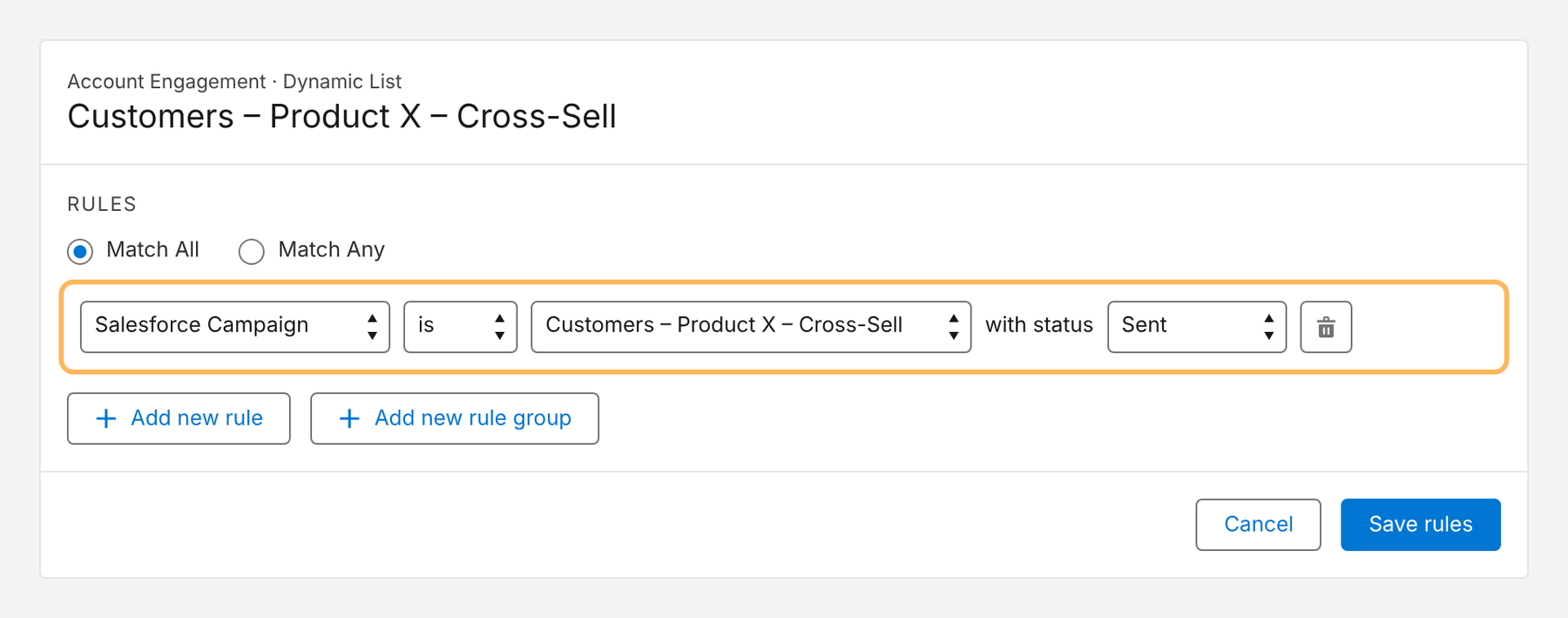
In Account Engagement, create a new dynamic list and add the rule Prospect Salesforce campaign → is → [your campaign]. If you use campaign member statuses, you can also filter on a specific status. From now on:
- the audience schedule updates the Salesforce campaign members,
- the members sync to Pardot,
- the dynamic list adds and removes prospects accordingly.
The result is a fully automated Pardot list based on data Pardot itself never sees.
Step 5: Make sure the records exist in Pardot
Remember limitation #2: only existing prospects end up on the list. If some of your target contacts aren’t in Pardot yet, sync them first. You can use an audience for that as well – see how to define which records sync from Salesforce to Pardot.
Working with very large target groups? Read how to add more than 50,000 campaign members in Salesforce.
5 practical examples
These are dynamic lists marketing teams build regularly – and what they need under the hood:
| Dynamic list | Rules | Works in Pardot alone? |
|---|---|---|
| Mailable prospects | Email is not empty, not opted out, not Do Not Email, not hard bounced | ✅ Yes |
| Hot leads | Score > 100 and Grade is A or B, not a customer | ✅ Yes |
| Cross-sell: customers without product Y | Account has a won opportunity with product X, but no opportunity product Y | ⚠️ Needs product data → campaign-member approach |
| Renewal campaign | Contract end date within the next 90 days, contact is decision maker | ❌ Contract data not in Pardot → campaign-member approach |
| Customer satisfaction follow-up | Case closed in the last 7 days, no other open case | ❌ Case data not in Pardot → campaign-member approach |
A good rule of thumb: if your criteria only use prospect, account or simple opportunity fields, build the list directly in Pardot. As soon as products, contracts, cases, activities or custom objects are involved, build the segment in Salesforce and let the dynamic list mirror the campaign.
Best practices and troubleshooting
Use a consistent naming convention. Prefixes like DL – (dynamic) and SL – (static), plus purpose and region, keep hundreds of lists manageable.
Build one “mailable” base list. Reference it via “is a member of list” in other lists instead of repeating the same opt-out and bounce rules everywhere.
Wait for the completion email. After creating or editing a large list, Pardot recalculates in the background. Sending before it has finished can reach the wrong people.
If the count doesn’t match your Salesforce report, check:
- Are all records synced as prospects – or stuck in the connector’s sync error queue?
- Can the connector user see the leads and contacts?
- Are prospects in the Pardot recycle bin?
- For opportunity rules: is the contact actually linked to the opportunity?
- Are there duplicate email addresses that Pardot handles differently from Salesforce?
Clean up regularly. Delete or convert dynamic lists that are no longer used – they still consume processing resources.
Conclusion
Pardot dynamic lists are one of the most useful features in Account Engagement: set up the rules once and your segments maintain themselves. Their weak spot is data access – anything beyond prospect, account and basic opportunity fields is out of reach.
By letting a Salesforce campaign do the segmenting and a dynamic list do the syncing, you remove that limit. With Campaign Audience Builder you can segment on any object in your Salesforce org, keep the campaign members up to date automatically, and feed the result straight into Pardot.
 Campaign Audience Builder
Fill Pardot lists with any Salesforce data
Campaign Audience Builder fills Pardot lists with segments from any Salesforce object – the data dynamic lists can't reach.
- Sync any Salesforce data into Pardot lists
- Segment across any standard or custom object
- Reach any tool via Flow or Apex
FAQ
How often do Pardot dynamic lists update?
Dynamic lists update automatically whenever a prospect's data changes – typically within minutes. Changes made in Salesforce first have to sync through the connector, so they appear in Pardot after the next sync cycle. When you create or edit a list, Pardot recalculates it completely and sends you an email when it's done.
Can I manually add prospects to a dynamic list?
No. Membership in a dynamic list is controlled exclusively by its rules. If you need manual additions, either change the prospect's data so it matches the rules, or combine the dynamic list with a static list in your send.
Should I use a static or a dynamic list?
Use a dynamic list for any segment that should stay current over time – mailable prospects, customers, target accounts. Use a static list when you need a fixed snapshot, e.g. everyone who attended a specific event, or when membership is set by automation rules and completion actions.
How do I add Salesforce campaign members to a Pardot list?
Create a dynamic list with the rule Prospect Salesforce campaign → is → [campaign], optionally filtered by member status. Every campaign member that exists as a prospect in Pardot is then added automatically. To keep the campaign itself up to date based on Salesforce criteria, use an automated audience as described above.
Can I use dynamic lists in Engagement Studio?
Yes. Dynamic lists can be used as recipient and suppression lists in Engagement Studio programs. Prospects that join the list later are picked up by the program automatically.