


The Pardot–Salesforce sync connects leads and contacts in Salesforce with prospects in Pardot (Account Engagement) and keeps their fields up to date in both directions. Which records end up in Pardot is controlled by three native levers: the connector user’s visibility, the “automatically create prospects” setting and Marketing Data Sharing. All three are coarse – and that’s where criteria-based sync rules with Campaign Audience Builder come in.
This article is part of our guide to Pardot segmentation.
A note on naming: Salesforce renamed Pardot to Marketing Cloud Account Engagement in 2022. The connector and its settings are the same. Since most admins still search for “Pardot”, we use both names.
How the Pardot Salesforce sync works
The Account Engagement connector (version 2 for all current accounts) links your Pardot business unit to your Salesforce org. It syncs:
- Leads and contacts ↔ prospects – the core of the sync, in both directions
- Accounts → prospect accounts, and opportunities for reporting and segmentation
- Campaigns (connected campaigns) and campaign membership
- Custom objects – in higher editions and only after configuration, and only if they are directly related to leads, contacts or accounts. Nested objects (e.g. a custom object below an opportunity or another custom object) can’t be synced.
Changes are picked up continuously; updates typically arrive in the other system within a few minutes. Large imports, sync errors or exhausted Salesforce API limits can slow this down.
The connector user
The connector reads and writes data as a dedicated Salesforce user – in connector v2 the B2BMA Integration User. Account Engagement can only sync records and fields this user has access to. Field-level security, sharing rules and permission sets for this user therefore directly decide what Pardot sees.
Field sync behavior
For every prospect field mapped to Salesforce, you decide which system wins when values differ:
| Sync behavior | When to use it |
|---|---|
| Use Salesforce’s value | Fields owned by sales or service, e.g. lead status, account owner, customer type |
| Use Account Engagement’s value | Fields owned by marketing, e.g. score, grade, marketing preferences |
| Use the most recently updated value | Fields both teams maintain, e.g. phone number or job title |
Which records sync? The 3 native controls
Getting fields right is only half of it. The bigger question in every implementation is: which Salesforce leads and contacts should become prospects at all?
1. Connector user visibility
The connector can only sync what the connector user can see. Restricting its access via sharing rules or record types limits which records reach Pardot.
Limits: Sharing is designed for security, not for marketing segmentation. Criteria are limited to what sharing rules can express, and every change affects a technical user that other processes may depend on.
2. “Automatically create prospects in Account Engagement if they are created as a lead or contact in Salesforce”
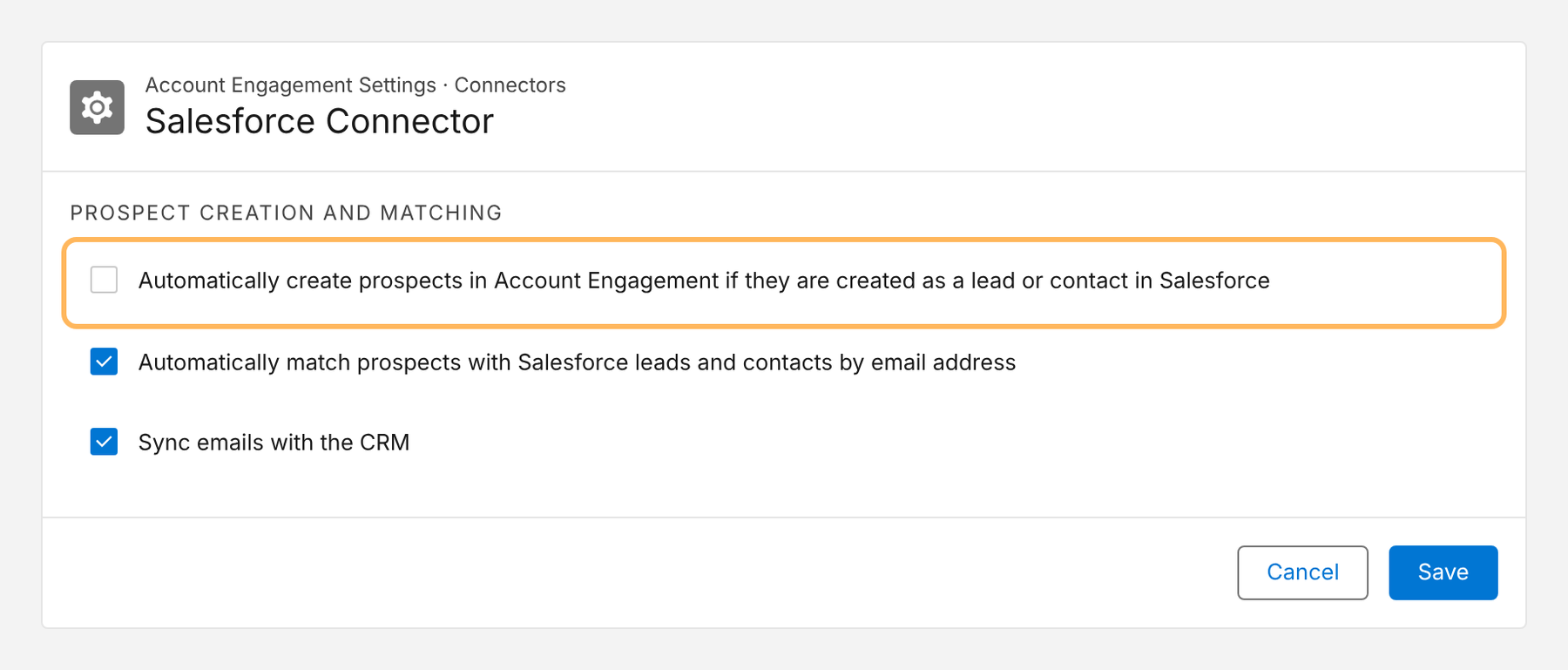
This connector setting is a switch:
- Enabled: every new lead or contact the connector user can see becomes a prospect – including records you’ll never email.
- Disabled: new Salesforce records only become prospects if you add them another way, for example via CSV import or list sync. Without automation, that means recurring manual work.
Limits: It’s all or nothing. There’s no way to say “only create prospects for contacts at customer accounts with an active contract”.
3. Marketing Data Sharing (MDS)
Marketing Data Sharing lets you define one rule per object (leads, contacts, opportunities, custom objects). Only records that meet the rule sync to Account Engagement; prospects whose record stops matching are moved to the recycle bin.
Limits:
- Only available in the Advanced and Premium editions with connector v2.
- One rule per object, based on fields of that object. Salesforce recommends a dedicated checkbox or picklist field for it.
- Leads and contacts share their rule configuration.
- Complex criteria (“contact at an account with a Closed Won opportunity for product X”) have to be pre-calculated into that field by additional automation.
The native controls compared
| Control | Edition | Criteria | Automation | Typical problem |
|---|---|---|---|---|
| Connector user visibility | All | Sharing rules, record types | Automatic | Mixes security and marketing logic |
| Auto-create setting | All | None – all or nothing | Automatic | Floods the database or requires manual imports |
| Marketing Data Sharing | Advanced, Premium | One field-based rule per object | Automatic | Complex criteria need helper fields + automation |
Why sync rules matter
Syncing every lead and contact sounds convenient, but it comes at a price:
- Cost: Account Engagement editions include a fixed number of contacts. Every additional block of contacts costs extra – even for records you never market to.
- Performance: A bloated database makes dynamic lists, automation rules and Engagement Studio slower and harder to manage.
- Data protection: Records without a marketing purpose – or without consent – shouldn’t sit in your marketing system at all.
- Data quality: Every unnecessary prospect is another potential duplicate and another source of sync errors.
Troubleshooting the sync
If records don’t show up in Account Engagement as expected, check these first:
- Sync errors queue: Validation rules, required fields or locked records in Salesforce block updates. Fix them in the sync errors list.
- Connector user permissions: Missing object, record or field access is the most common reason for “missing” prospects.
- Duplicate email addresses: Account Engagement matches on email address; duplicates in Salesforce lead to unexpected matches.
- Recycle bin: Deleted or archived prospects don’t come back automatically when the Salesforce record changes.
The setup with Campaign Audience Builder: criteria-based sync rules
The native controls answer whether records sync – but not which ones based on your business logic. That logic usually depends on data spread across several objects: account type, opportunities and products, contracts, cases, custom objects.
Campaign Audience Builder solves this directly in Salesforce. You define the sync criteria as an audience – on any object, with AND/OR logic and exclusions – and CAB keeps an Account Engagement list in sync with it. Records that match are added automatically and become prospects; nothing else gets into your database.
Which problems the setup solves
| Known problem | How the CAB setup solves it |
|---|---|
| Auto-create is all or nothing | Keep auto-create disabled – CAB only adds records that match your criteria |
| Disabled auto-create means manual imports | The audience runs on a schedule and adds new matching records automatically |
| MDS allows one field-based rule per object | Criteria on any related object, as many audiences as you need |
| Complex criteria need helper fields and Flows | No helper fields – the logic lives in the audience, built with clicks |
| MDS needs Advanced or Premium | Works independently of the MDS edition requirement |
| Only custom objects directly on leads, contacts or accounts sync | Criteria on custom objects at any level of the data model – nothing has to be synced to Account Engagement |
| Sync logic is invisible to marketing | Sync rules are readable audiences that marketing and admins can review |
Step by step
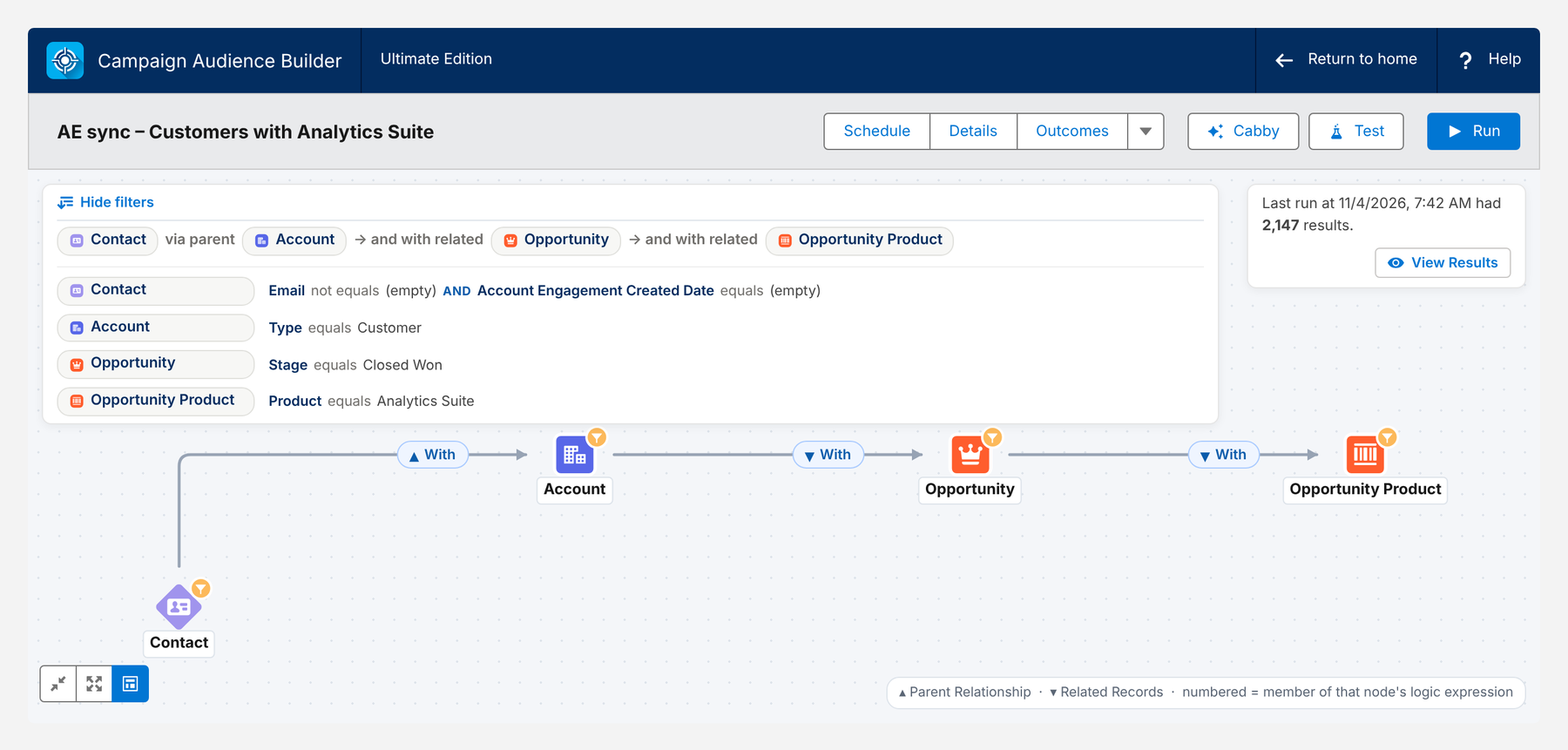
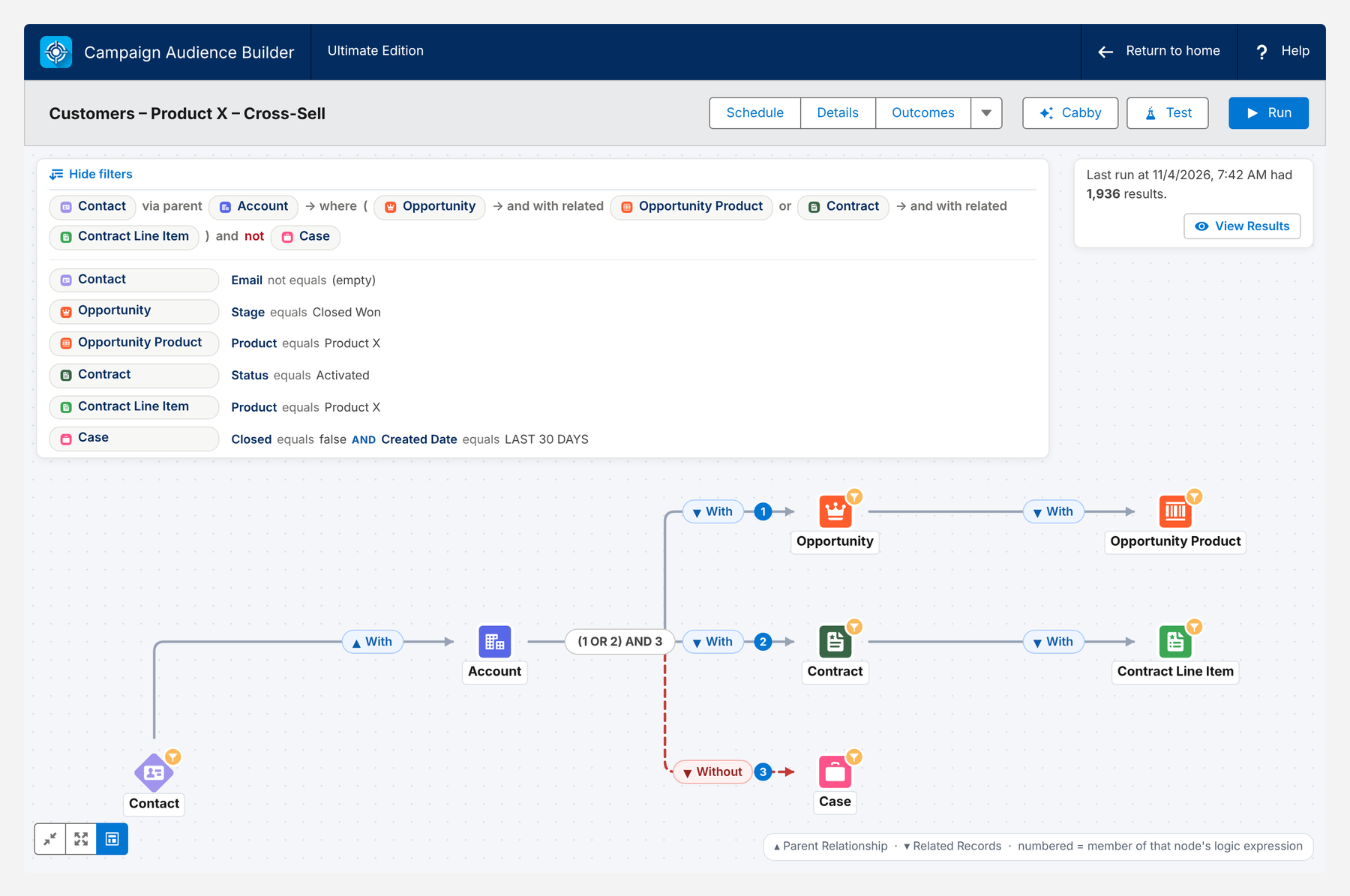
Example: Automatically sync all contacts with an email address at customer accounts that have a Closed Won opportunity with a specific product – but only if they don’t exist in Account Engagement yet.
1. Disable auto-create. In the connector settings, keep “Automatically create prospects…” switched off, so only your rules decide what syncs.
2. Build the audience. In Campaign Audience Builder, create a contact audience with your criteria: Email is not empty, Account Type is Customer, the account has a Closed Won opportunity with the product. Add Account Engagement Created Date is empty so only records that aren’t prospects yet are picked up.
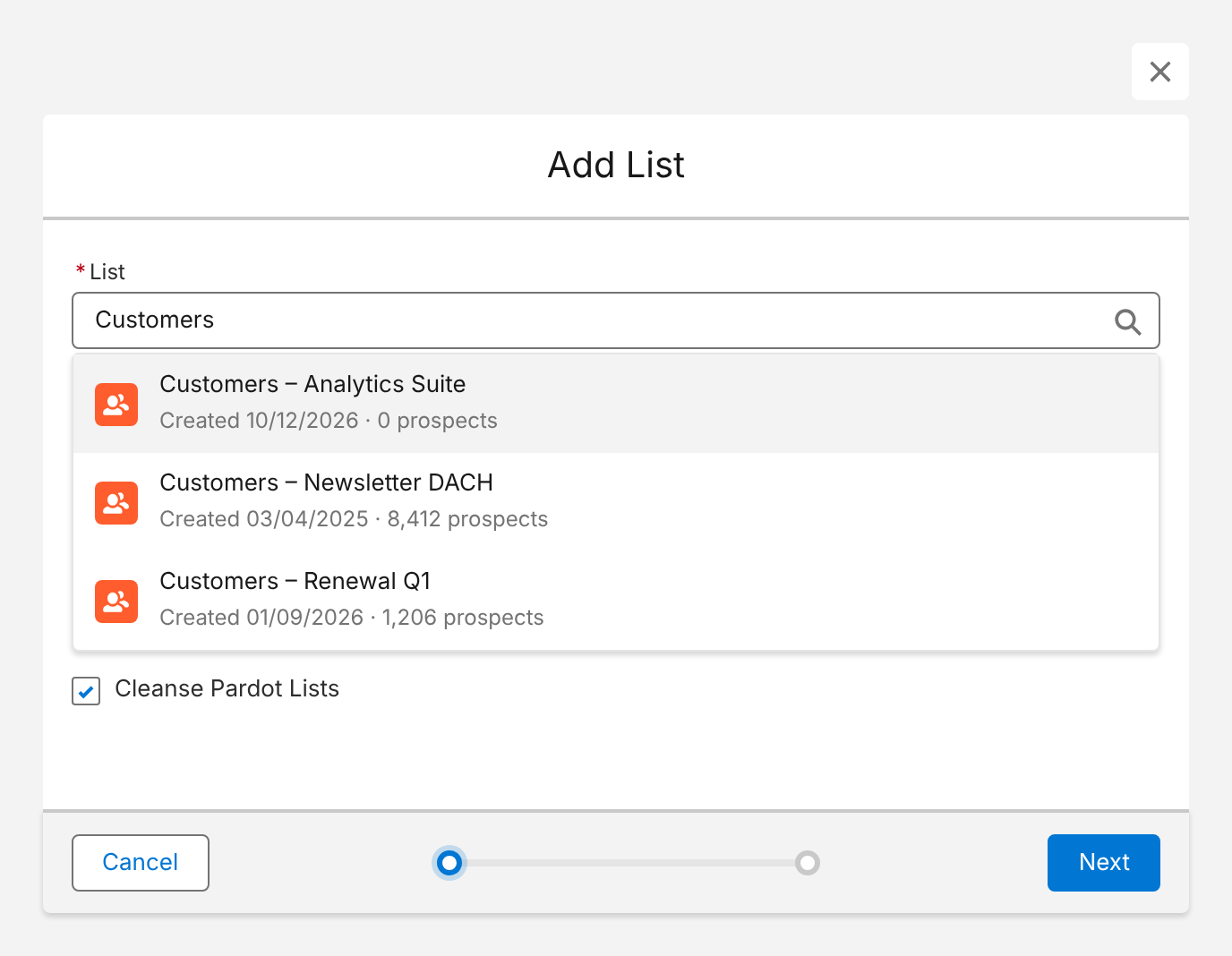
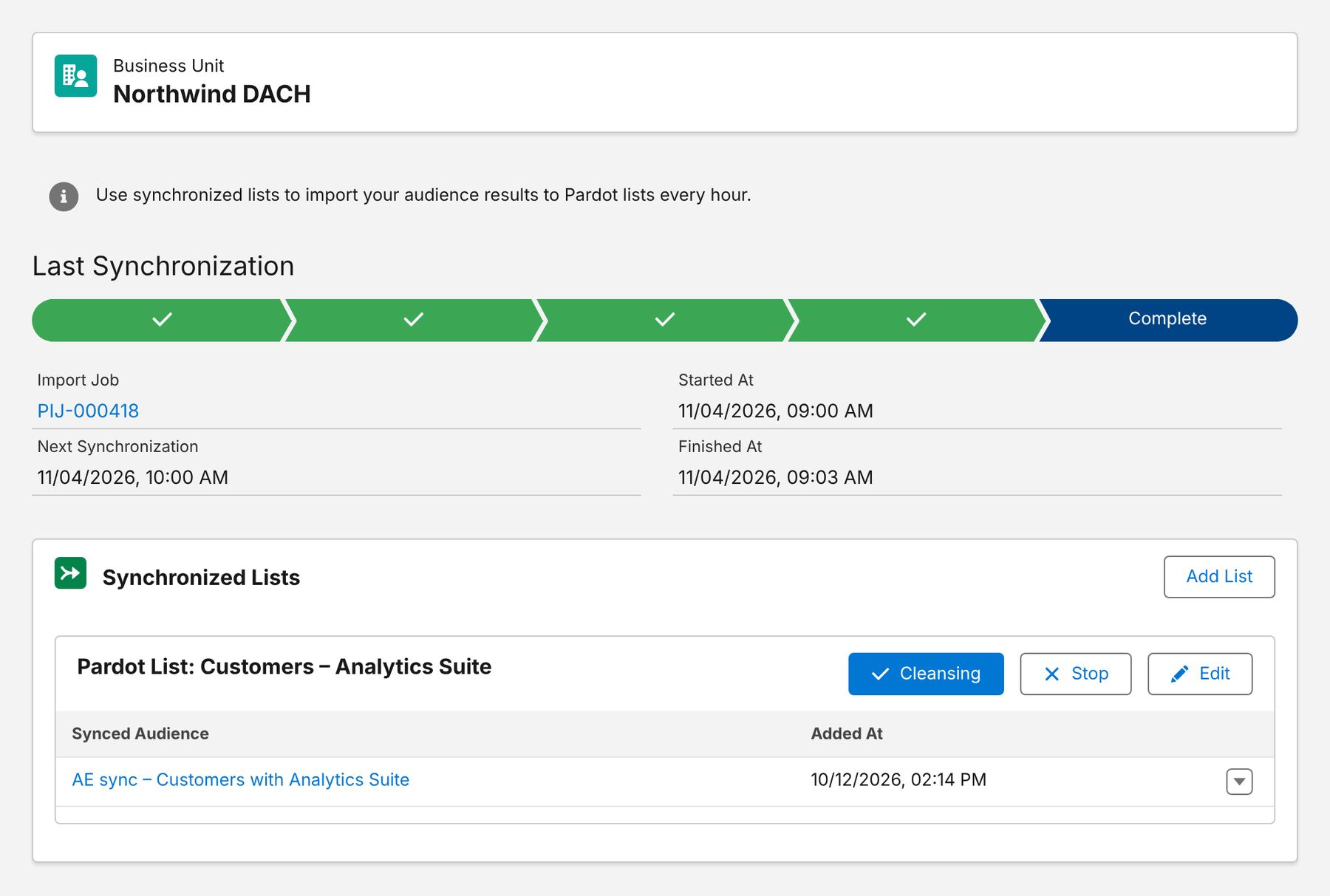
3. Select the Account Engagement list. In the audience’s sync setup, choose the list the records should be added to.
4. Assign the audience. Select the audience (or several) that should feed the list.
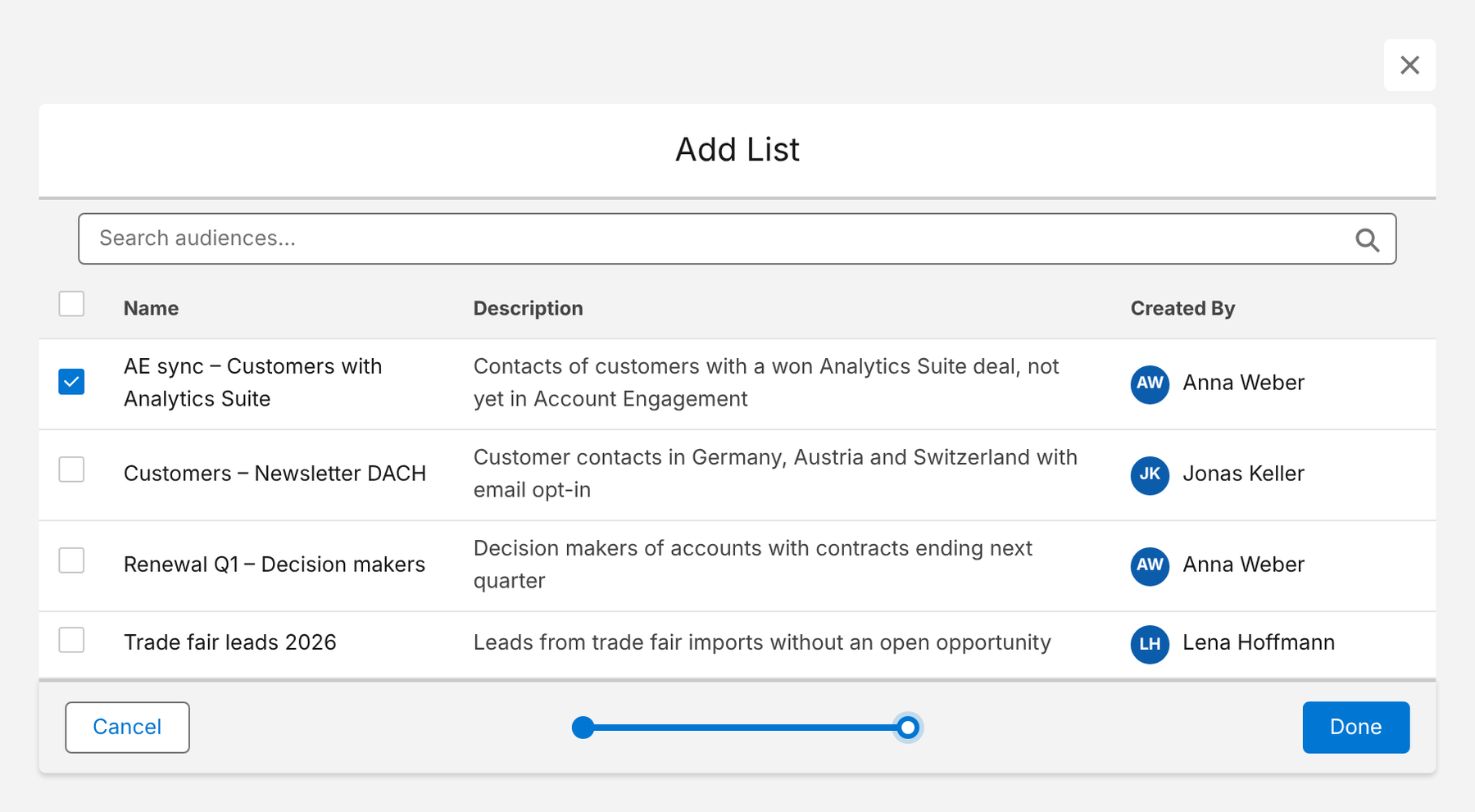
5. Schedule and activate. From now on, every new record that matches the criteria is added to the list automatically and created as a prospect.
Initial migration and ongoing sync in one
The same audience covers both phases of an implementation:
- Initial data migration: the first run brings all existing records that match your criteria into Account Engagement – no CSV export, no import mapping.
- Ongoing sync: every following run adds new records as soon as they match – for example when a contact’s account becomes a customer.
To keep the database lean over time, combine it with a clean-up audience for records that no longer qualify, and use dynamic lists for segmentation inside Account Engagement.
Conclusion
The Pardot–Salesforce sync is reliable once it’s set up – but the native controls only offer three blunt levers: technical visibility, an all-or-nothing switch and a single field-based rule per object in the higher editions.
With Campaign Audience Builder, you keep auto-create off and define exactly which records become prospects, using criteria on any Salesforce object. New matching records flow into Account Engagement automatically – for the initial migration and every day after – without helper fields, manual imports or a bloated database.
 Campaign Audience Builder
Target Pardot lists with any Salesforce data
Campaign Audience Builder targets Pardot lists with any Salesforce data, so your segments don't depend on which fields sync.
- Sync any Salesforce data into Pardot lists
- Segment on any Salesforce object
- Reach any tool via Flow or Apex
FAQ
How often does Pardot sync with Salesforce?
The Account Engagement connector syncs changes continuously in the background; updates typically appear in the other system within a few minutes. Large data volumes, sync errors or exhausted Salesforce API limits can delay the sync.
What does "Automatically create prospects in Account Engagement if they are created as a lead or contact in Salesforce" do?
When this connector setting is enabled, every new lead or contact the connector user can see is created as a prospect in Account Engagement. When it's disabled, new Salesforce records only become prospects if you add them another way – for example via import, a list sync or a sync rule.
What is the Account Engagement connector user?
The connector user is the Salesforce user the connector uses to read and write data – in connector v2 the B2BMA Integration User. Account Engagement can only sync the leads, contacts and fields this user has access to.
Can I sync only some leads and contacts from Salesforce to Pardot?
Yes. Natively you can limit the connector user's visibility or use Marketing Data Sharing (Advanced and Premium editions, one rule per object). For criteria across several objects, you can keep auto-create disabled and sync a criteria-based audience to an Account Engagement list with Campaign Audience Builder.
What happens to a prospect when its Salesforce record no longer matches?
With Marketing Data Sharing, prospects whose Salesforce record stops matching the rule are moved to the Account Engagement recycle bin. Without MDS, existing prospects stay in Account Engagement until you remove them, so clean-up has to be part of your sync concept.