


Salesforce’s built-in tools stop at 50,000 records: “Add to Campaign” from a report and the Data Import Wizard can’t handle larger target groups in one go. To add more campaign members, you need Data Loader, Apex – or a segmentation app like Campaign Audience Builder, which adds any number of members directly from an audience, refreshes them on a schedule and removes records that no longer match.
This guide compares every way to add campaign members, explains why the “Add to Campaign” button is greyed out, and shows what to watch out for when campaigns get really large.
All ways to add campaign members – and their limits
| Method | Max. records per action | Criteria | Automation | Best for |
|---|---|---|---|---|
| List view → “Add to Campaign” | 200 selected records | One object, list view filters | No | Quick manual additions |
| Report → “Add to Campaign” | Fewer than 50,000 | Report type + filters, max. 3 cross filters | No | One-off segments up to 50k |
| Data Import Wizard (Manage Members → Import) | 50,000 | None – CSV based | No | Event lists, purchased lists |
| Data Loader | Up to 5 million | None – CSV based | Only with scripting | Large one-time loads |
| Flow | Limited by governor limits (10,000 DML rows per transaction) | Flow logic | Yes | Small, event-driven additions |
| Apex (batch) | Millions | SOQL | Yes | Developer-built, custom logic |
| Campaign Audience Builder | No practical limit – millions of members | Any object, AND/OR, exclusions | Yes – scheduled, incl. removal | Recurring segments of any size |
Why is “Add to Campaign” greyed out?
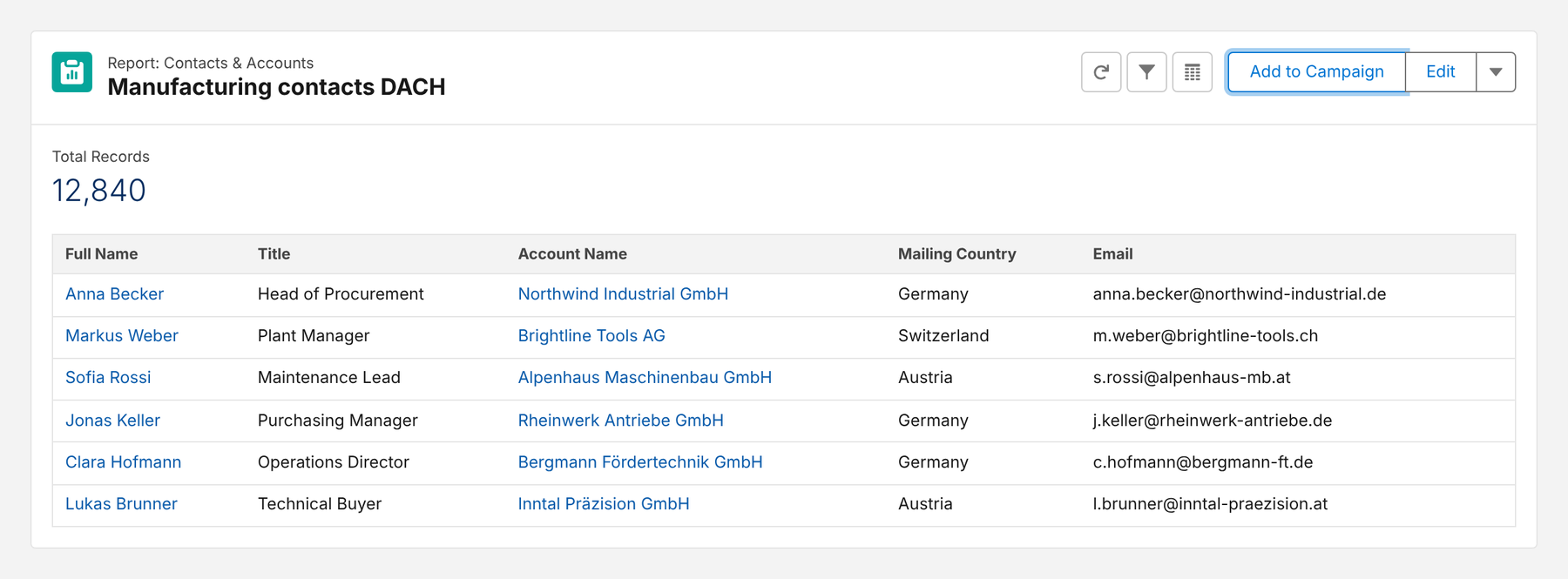
If the button is disabled or missing, check these points:
- The report returns 50,000 records or more. Salesforce disables the button – reduce the result set below 50,000. The limit and the other requirements below are documented in the Salesforce Help article on adding campaign members from a report.
- The report isn’t saved. The button only appears in saved reports, not while editing or previewing.
- Detailed rows are hidden. “Show Detail Rows” must be switched on.
- Wrong primary object. The report must return leads, contacts or person accounts. In Lightning, custom report types also need the Full Name field.
Also good to know: converted leads in the report are skipped, records edited during the process aren’t added, and members are added in batches – if you interrupt, some members may already be on the campaign.
Adding more than 50,000 campaign members: the workarounds
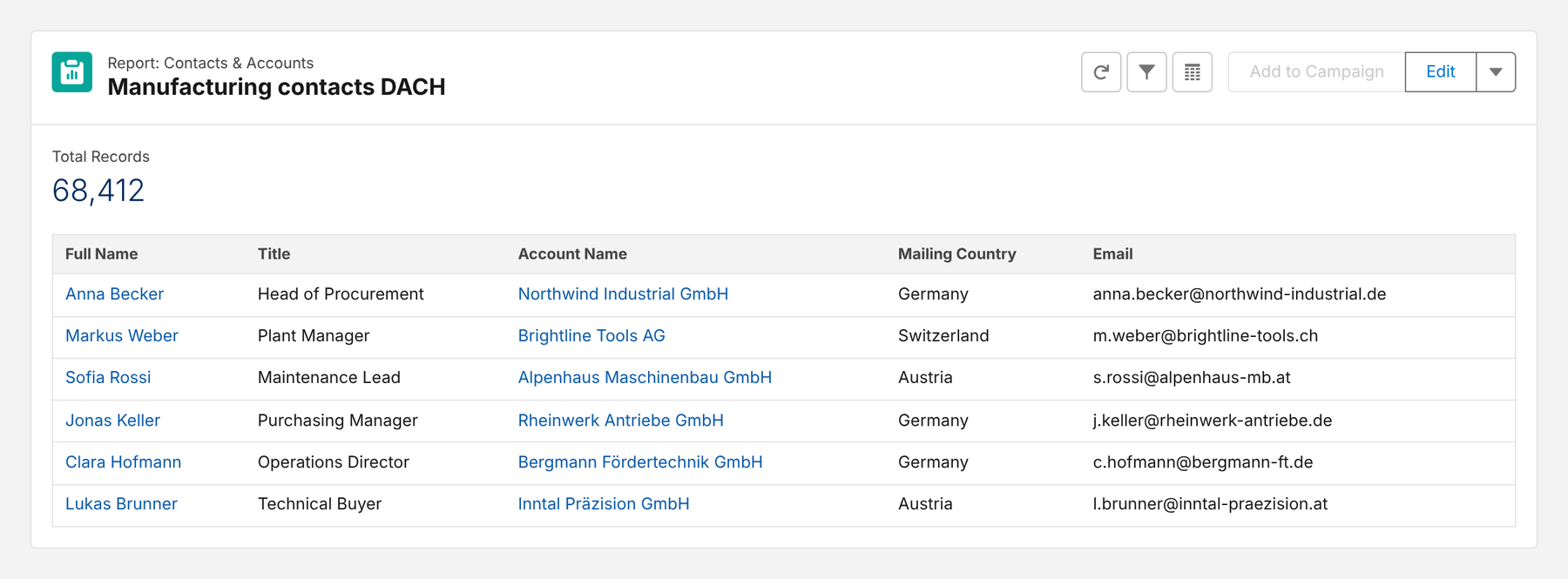
For most campaigns, 50,000 is plenty. But B2C companies, nonprofits with large donor bases and enterprise orgs regularly target hundreds of thousands of contacts. These are the common ways around the limit:
1. Split the report into chunks
Add filters that slice the target group into parts below 50,000 – by country, by first letter of the last name, by created date – and run “Add to Campaign” for each part.
Downside: tedious and error-prone. Overlaps or gaps between chunks are easy to miss, and the whole procedure has to be repeated for every refresh.
2. Export and load with Data Loader
Export the report as CSV, map the record IDs to a campaign member file (CampaignId, LeadId or ContactId, Status) and insert it with Data Loader.
Downside: requires Data Loader access and export permissions, sensitive data leaves Salesforce, and the result is a snapshot – new matching records aren’t added, outdated ones aren’t removed.
3. Apex batch
A developer writes SOQL for the target group and a batch class that creates campaign members in chunks.
Downside: every new segment or criteria change needs developer time, testing and deployment. Logic ends up in code that marketing can’t read or adjust.
Large data volume: what to watch out for
Once campaigns reach hundreds of thousands or millions of members, a few more things matter:
- Storage: like most records, a campaign member counts as roughly 2 KB of data storage. One million members ≈ 2 GB. Old campaigns with huge member lists add up quickly.
- Performance: campaign member related lists, reports and list views slow down with very large campaigns. Use selective filters and avoid unfiltered reports across all members.
- Clean-up: members that no longer fit – churned customers, opt-outs, contacts who left the company – stay on the campaign until someone removes them. Plan removal from the start.
- Archiving: for campaigns that are finished, export the member data you need for reporting and delete the members to free up storage.
- Connected tools: if campaigns sync to Account Engagement (Pardot) or Marketing Cloud, every added member creates sync load. Add only the members you’ll actually market to – see Pardot sync rules.
How to export campaign members
To export the contacts and leads of a campaign:
- Report: create a report with the report type Campaigns with Contacts or Campaigns with Leads (or a campaign member report type), filter by campaign and export.
- Data Loader: export the CampaignMember object with a filter on
CampaignId– the most reliable option for very large campaigns.
The setup with Campaign Audience Builder
All workarounds share the same problems: manual steps, snapshots that go stale, and either a 50,000 limit or a dependency on technical skills. Campaign Audience Builder removes them by turning the target group into an audience that manages the campaign members for you.
Which problems the setup solves
| Known problem | How Campaign Audience Builder solves it |
|---|---|
| “Add to Campaign” stops at 50,000 records | Audiences add any number of members – CAB processes millions of campaign members |
| Report types limit the criteria | Criteria on any standard or custom object, with AND/OR logic and exclusions |
| Chunking reports and exports is manual | One audience, one click – no splitting, no CSV files |
| Campaigns go stale | Audiences run on a schedule and add new matching records automatically |
| Outdated members stay on the campaign | Campaign cleansing removes members that no longer match |
| Repeated runs process everything again | Delta processing only applies changes since the last run |
| New segments need developers | Marketers and admins build audiences with clicks |
Step by step
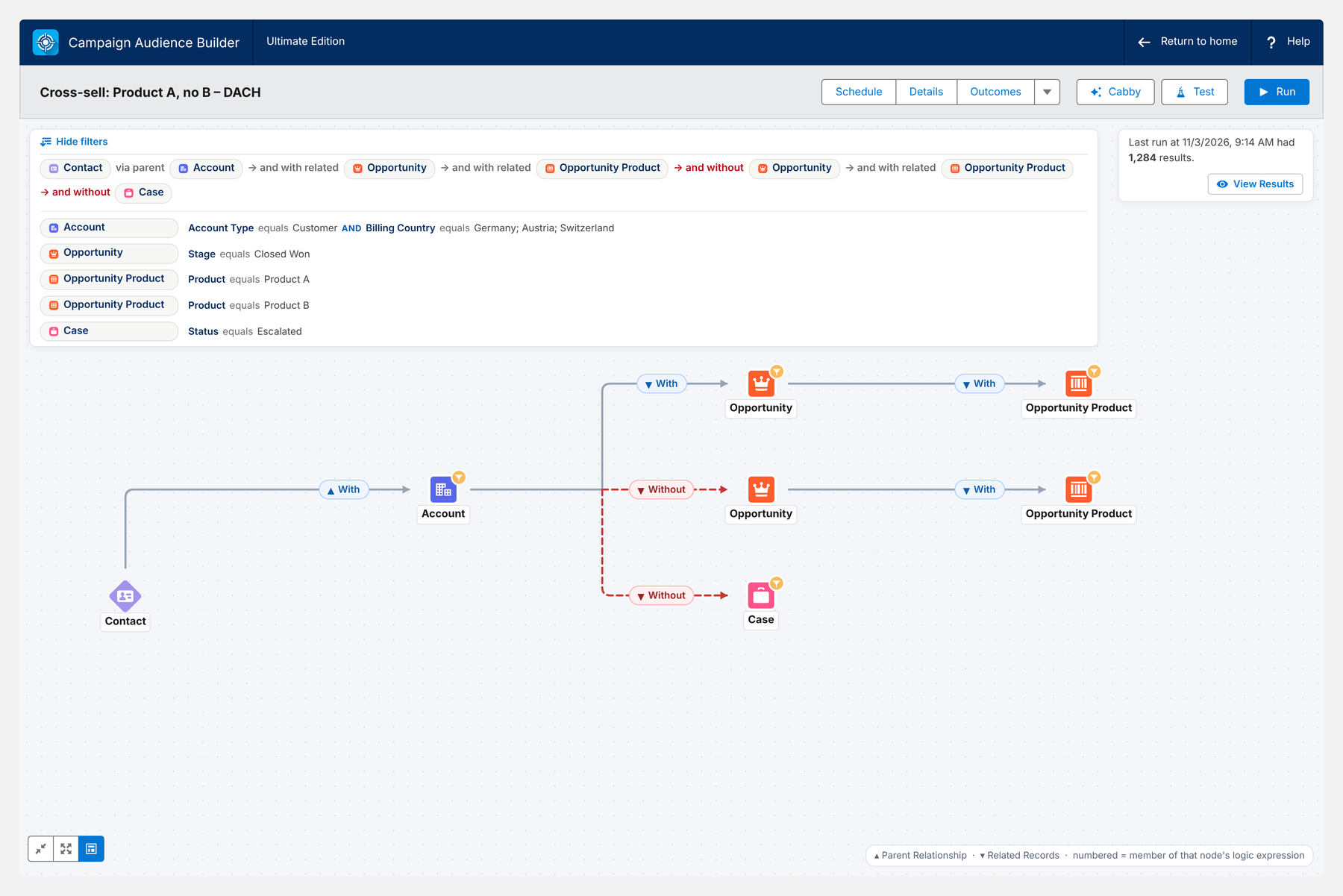
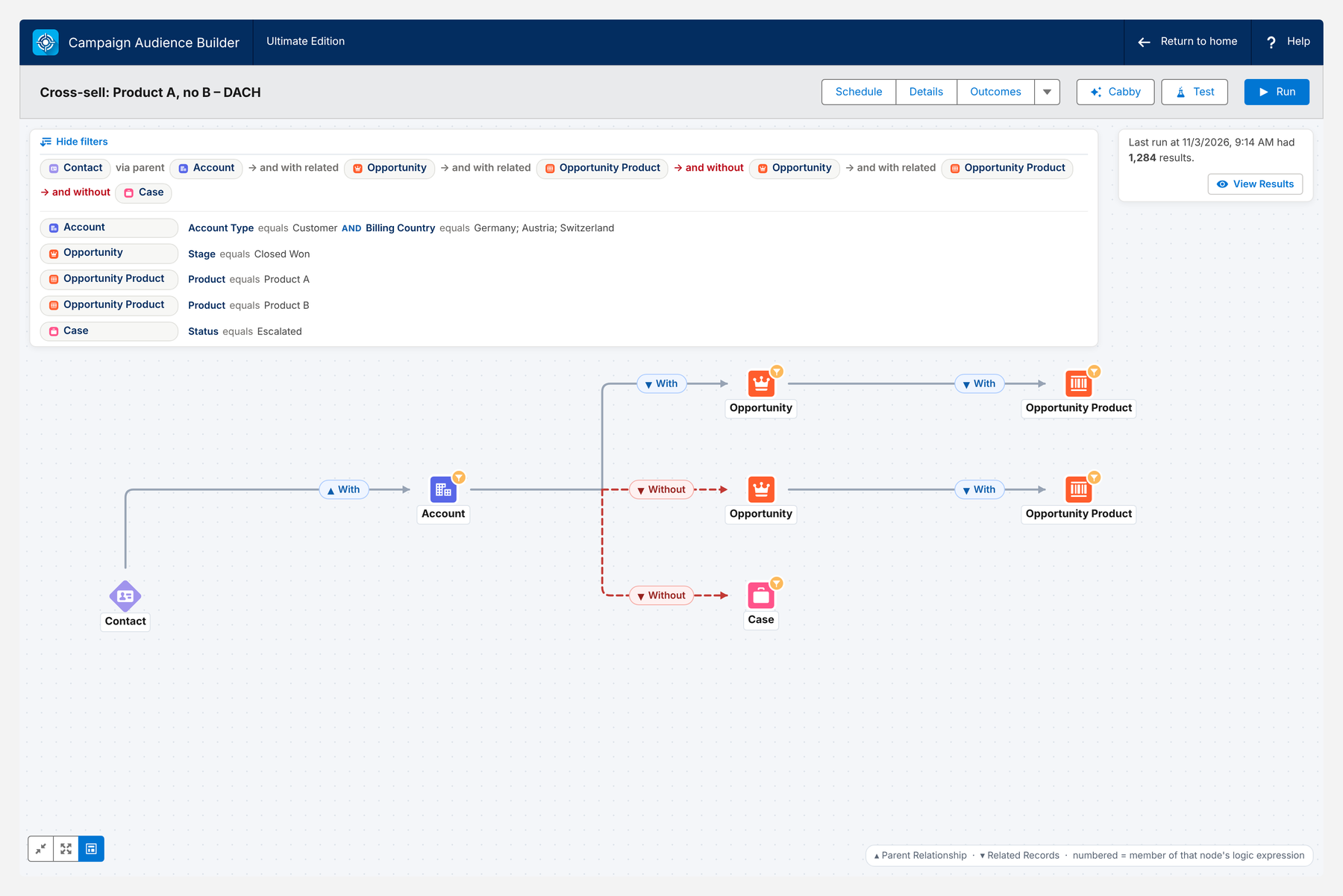
- Build the audience. Create a contact or lead audience in Campaign Audience Builder and define the criteria – on contact, account, opportunities, products or any custom object.
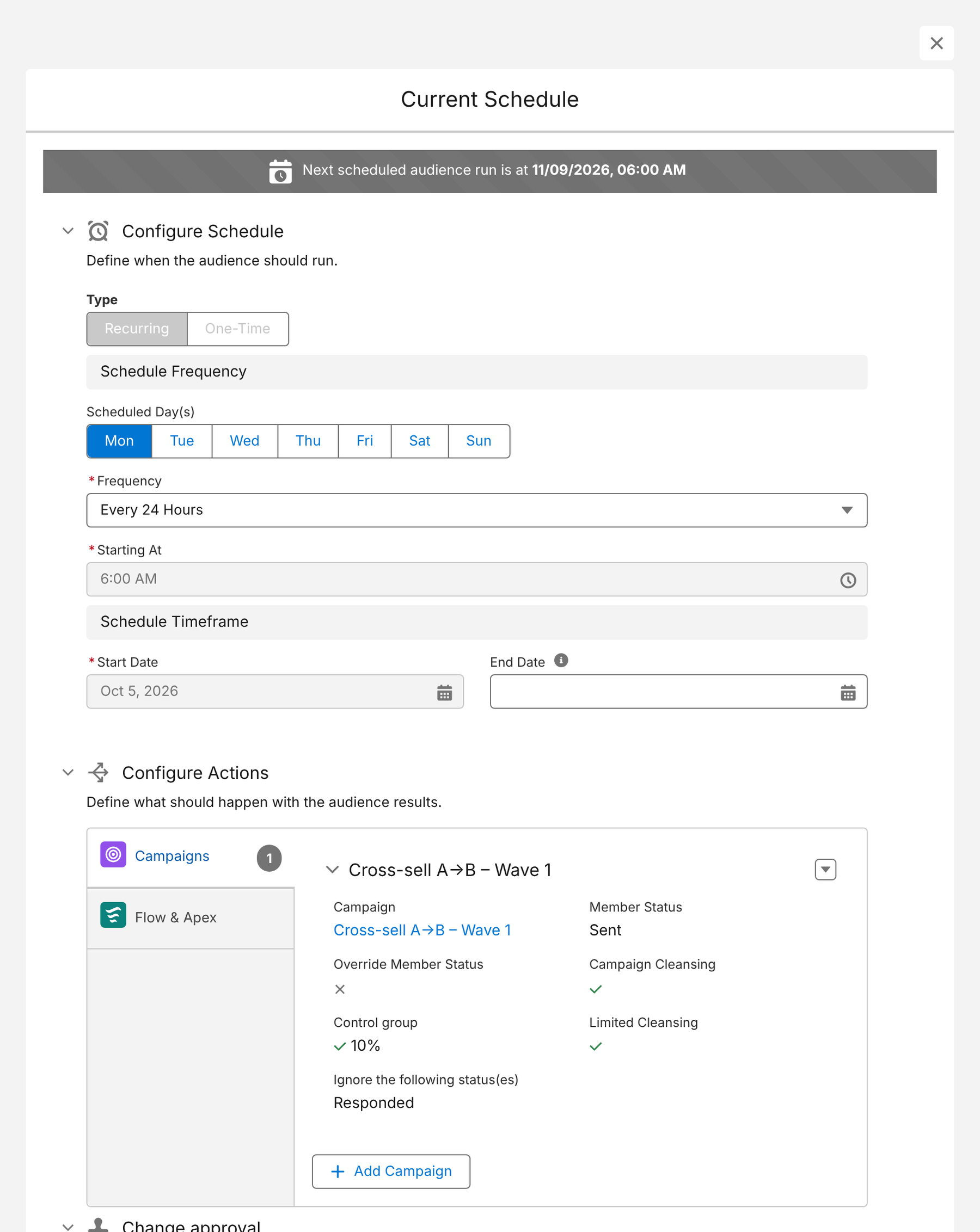
- Select the campaign. Choose the target campaign and the member status for new members.
- Run it. CAB adds all matching records as campaign members – whether that’s 5,000 or 5 million.
- Schedule it. Let the audience refresh daily or weekly so new matching records are added automatically.
- Enable cleansing. Remove members automatically as soon as they no longer meet the criteria.
Duplicate members are a separate topic – see how to deduplicate campaign members. And if the campaign feeds Account Engagement, the members can flow straight into a Pardot dynamic list.
Conclusion
The 50,000-record limit is built into Salesforce’s point-and-click tools – “Add to Campaign” and the Data Import Wizard. Splitting reports, Data Loader and Apex get around it, but each comes with manual effort, stale snapshots or developer dependency.
With Campaign Audience Builder, campaign size stops being a factor: audiences add any number of members, keep them up to date on a schedule and remove those that no longer fit – so large campaigns are as easy to manage as small ones.
 Campaign Audience Builder
Add 50,000+ campaign members in one run
Campaign Audience Builder adds large audiences to a campaign in one run – and on repeat runs only processes the members who changed.
- Add 50,000+ campaign members in one run
- Process only what changed
- Deduplicate and export exactly what you need
FAQ
Is there a limit on campaign members per campaign in Salesforce?
There is no fixed limit on how many members a campaign can have. The limits apply to the tools you use to add them: "Add to Campaign" from a report and the Data Import Wizard handle up to 50,000 records at a time, while Data Loader, Apex and segmentation apps can process much larger volumes.
Why is the "Add to Campaign" button greyed out in my report?
The button is disabled when the report returns 50,000 records or more. It also only appears in saved reports with detailed rows shown, and the report's primary object must be lead, contact or person account (in Lightning, custom report types also need the Full Name field).
How do I add more than 50,000 campaign members?
Either split the target group into several reports below 50,000 records, export the records and load campaign members with Data Loader, write Apex batch code – or use a segmentation app like Campaign Audience Builder, which adds any number of members directly from an audience and keeps them up to date on a schedule.
How much storage does a campaign member use?
Like most standard records, a campaign member counts as roughly 2 KB of data storage. A campaign with one million members therefore uses around 2 GB – which is why cleaning up old campaign members matters in large orgs.
How do I remove campaign members in bulk?
Natively, you can remove members via the campaign's Manage Members page, a Data Loader delete based on a campaign member export, or Apex. Campaign Audience Builder's campaign cleansing removes members automatically as soon as they no longer match the audience criteria.