

Major donor and mid-level segmentation in Salesforce means defining giving bands based on your own data, tagging every donor with the right band, and building separate journeys for each: personal relationship management for major donors, a dedicated program for mid-level donors, and upgrade paths for everyone in between. NPSP and Nonprofit Cloud hold the giving history you need. The work lies in turning it into reliable, current segments – and in keeping mass appeals away from the donors who deserve a personal conversation.
This article is part of our guide to donor segmentation in Salesforce.
Major, mid-level, general: three bands, three approaches
| Band | Typical definition | How you engage them |
|---|---|---|
| Major donors | Total giving in the last 12 months at or above your major gift threshold | Personal relationship with a gift officer, individual asks, tailored impact reporting |
| Mid-level donors | Giving below the major threshold but well above the average gift | Dedicated program: special updates, recognition, events, personal touches at scale |
| General donors | Everyone else | Appeals, newsletters, digital journeys – with upgrade paths to mid-level |
The mid-level band is the one most organizations under-serve. These donors are often loyal and generous, but they receive the same appeals as first-time givers – while they are the most natural pool for future major donors.
Setting thresholds with your own data
There is no universal number. A threshold that defines “major” for a small local charity is a mid-level gift for a national organization. Set yours from your own gift distribution:
- Group donors into giving bands by total giving in the last 12 months – for example under 100, 100–499, 500–999, 1,000–4,999, 5,000–24,999 and 25,000+ in your currency.
- Look at two numbers per band: how many donors and how much income.
- Find the concentration point. The major gift threshold is usually where a small share of donors starts to account for a large share of income – and where your gift officer capacity matches the number of donors above it.
- Define mid-level as the band below, wide enough to be a meaningful program but small enough for more personal treatment.
- Review once a year, ideally when you plan the next fundraising year.
Two definitions to decide up front:
- Rolling 12 months or fiscal year? Rolling 12 months reacts faster – a donor who gives a large gift in March is major immediately. Fiscal-year totals are easier to align with targets and reporting.
- Do soft credits count? Gifts via a donor-advised fund, a family foundation, a company match or a peer-to-peer page often reflect the same relationship. Decide which soft credits count and use the same rule everywhere.
Where the data lives in NPSP and Nonprofit Cloud
In NPSP, contacts and household accounts carry rollup fields such as Total Gifts Last N Days (365 days by default), Total Gifts This Year, Largest Gift and Last Gift Date. NPSP Levels can assign a level – for example “Mid-level” or “Major” – based on one of those fields, and update it as giving changes. Gift officers are usually represented as the contact or account owner, or in a custom relationship manager field.
In Nonprofit Cloud, gifts are gift transactions on person accounts, with giving summaries on the donor gift summary where configured. Relationship management is built around portfolios, which assign donors to the fundraisers who manage them.
Either way, the band itself is easy to determine. The useful segments need more than one field.
8 segments for major and mid-level fundraising
| # | Segment | Criteria | Purpose |
|---|---|---|---|
| 1 | Current major donors | Giving in the last 12 months at or above the major threshold | Portfolio assignment, personal stewardship |
| 2 | Major donors at risk | Major in the previous 12 months, no gift in the last 6 months | Personal outreach before they lapse |
| 3 | Mid-level donors | Giving in the mid-level band in the last 12 months | Mid-level program communication |
| 4 | Mid-level loyalists | Mid-level band in each of the last three years | Recognition, insider updates, legacy conversations |
| 5 | Major gift prospects | Mid-level, several gifts per year, rising totals compared with the previous year | Qualification by a gift officer |
| 6 | Upgrade candidates | General donors with three or more gifts in 24 months and a growing average gift | Mid-level upgrade ask |
| 7 | One-time large gifts | Single gift at major level, no other gifts in 24 months | Thank and qualify – windfall or relationship? |
| 8 | Unassigned major donors | Major band but no gift officer or portfolio | Assign before the next appeal |
Segments 2, 4, 5, 6 and 7 compare periods, count gifts or look at the pattern of giving. A single rollup field or an NPSP Level can’t express them – you need conditions on the gift records themselves.
Portfolios: keep mass appeals away from major donors
The most expensive mistake in major donor fundraising is sending a generic appeal letter to someone whose gift officer is preparing a personal ask. Three rules prevent it:
- Exclude portfolio donors from mass appeals. Every appeal segment excludes donors with an assigned gift officer or portfolio – in addition to the major band itself, since not every major donor is assigned yet.
- Keep them in stewardship. Impact reports, thank-you messages and event invitations still go to them – just not the donation request.
- Make the exclusion automatic. When a donor moves into the major band or gets a gift officer, they should leave the mass appeal segments without anyone remembering to remove them.
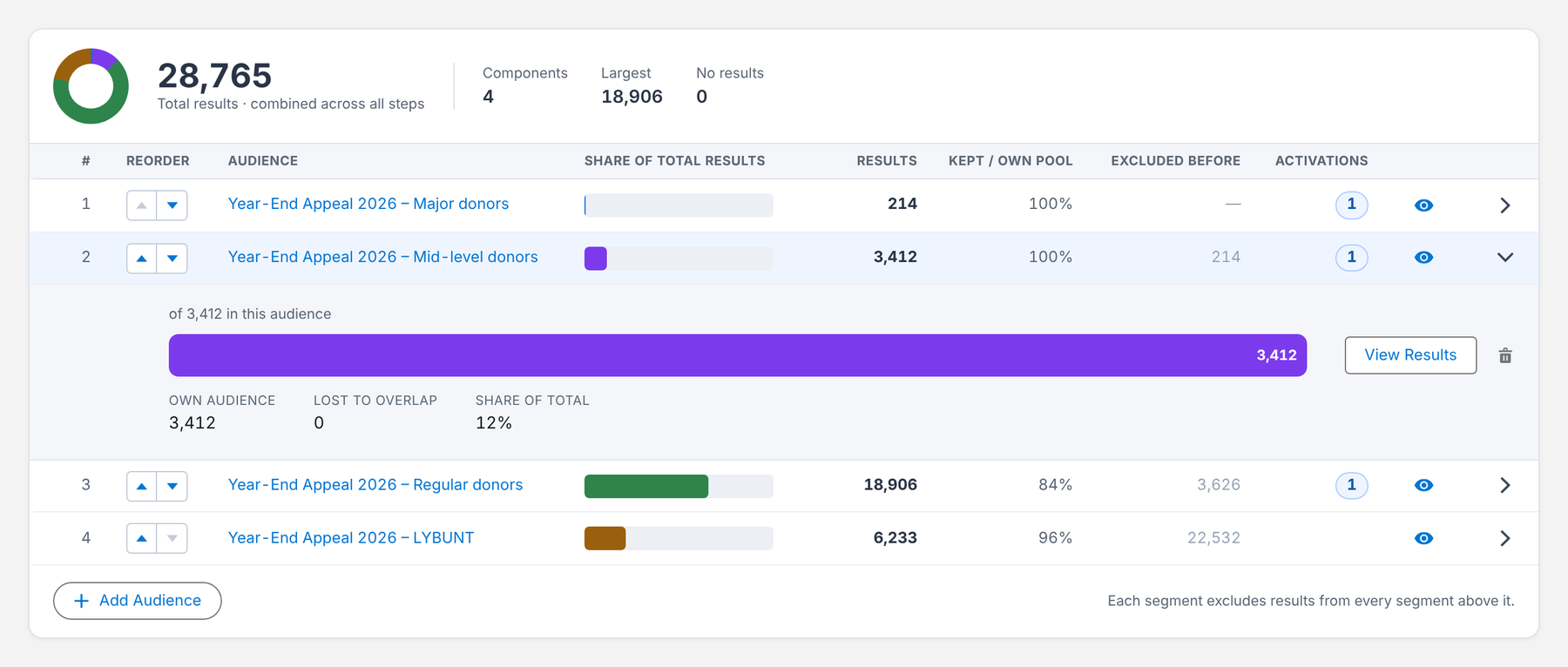
The same applies to the mid-level program: mid-level donors receive their own appeal version, not the general one – which is easiest with a waterfall that assigns each donor to exactly one band.
Building a mid-level program
A mid-level program doesn’t need gift officers for every donor. It needs a segment that is always current and communication that feels more personal than the general appeal:
- A distinct identity: a named giving circle or club with its own updates.
- Impact reporting: what their level of giving achieved, more often and more specific than in the general newsletter.
- Recognition: a call or handwritten note from a staff member after a gift, invitations to briefings or site visits.
- A clear upgrade path: recurring giving at mid-level amounts, and a personal conversation for prospects (segment 5).
Measure it like any program: response, average gift and upgrades to major, compared with a control group.
Native tools and their limits
| Tool | Good for | Where it stops |
|---|---|---|
| NPSP Levels | Tagging donors by band based on one rollup field | One criterion per level – no trends, counts across periods, causes or portfolio logic |
| Rollup fields | Totals and dates per donor | Comparing periods requires additional fields or formulas |
| Reports | Lists by band, totals by owner | Max. four objects per report type, three AND-only cross filters, snapshots, 50,000 records per “Add to Campaign” |
| Flows | Assigning levels or owners automatically | Every new segment rule becomes an admin task |
That’s why many teams maintain major and mid-level lists in spreadsheets next to Salesforce – which is exactly where portfolio exclusions get lost.
Major and mid-level segments with Campaign Audience Builder
With Campaign Audience Builder, the bands and the segments around them are audiences on your NPSP or Nonprofit Cloud data:
- Bands from gift records: aggregates such as “sum of gift transactions in the last 12 months between 1,000 and 4,999”, with or without soft credits.
- Patterns, not just totals: count gifts per period, require gifts in each of the last three years, or combine “major last year” with “no gift in the last six months”.
- Portfolio exclusions: exclude donors with a gift officer, portfolio or open major gift opportunity in every appeal audience – reusable as a locked filter from the Filter Library.
- One version per donor: a waterfall assigns each donor to exactly one band – major, mid-level, general – before the appeal goes out.
- Always current: scheduled refreshes move donors between bands as they give, and campaign cleansing removes them from audiences they no longer belong to.
Conclusion
Major and mid-level segmentation starts with thresholds based on your own giving distribution and a clear rule for soft credits. From there, the value is in the segments around the bands: donors at risk, loyal mid-level supporters, prospects with rising giving – and the portfolio exclusions that keep personal relationships out of mass appeals. Build them on gift records rather than single rollup fields, keep them current automatically, and give your mid-level donors a program of their own. That’s where many of your future major donors are waiting.
How Campaign Audience Builder helps
Campaign Audience Builder runs natively in Salesforce and turns NPSP or Nonprofit Cloud data into appeal audiences – without reports, exports or manual list work.
- Segment on gifts, totals, recurring donations, soft credits and designations
- Prioritize appeals with waterfall sequences and send one letter per household
- Remove donors who gave since selection and measure gifts against a control group
FAQ
What is a major donor?
A major donor is a supporter whose giving is large enough to justify personal relationship management by a gift officer or leadership. There is no universal threshold: it depends on your organization's size and gift distribution. Many nonprofits set it where the top few percent of donors begin, based on total giving over the last 12 months.
What is a mid-level donor?
Mid-level donors give more than the average donor but less than your major gift threshold. They are often loyal, under-served and the most important source of future major donors – which is why many nonprofits run a dedicated mid-level program with its own communication and recognition.
How do I set major and mid-level thresholds?
Start from your own data: group donors by total giving in the last 12 months into bands and look at how many donors and how much income each band represents. The major gift threshold is usually where a small share of donors accounts for a large share of income; the mid-level band sits below it. Review the thresholds once a year.
Should major donors receive mass appeals?
Usually not. Donors in a gift officer's portfolio should be excluded from mass appeals and receive personal asks instead. They should still receive impact reports and stewardship communication – just not the generic donation request.
How do NPSP Levels help with donor segmentation?
NPSP Levels assign a level to a contact or account based on a single rollup field, for example total giving in the last 365 days. They are a simple way to tag donors as mid-level or major. For segments that combine several criteria – trends, causes, soft credits or portfolio ownership – you need additional logic.
Do soft credits count toward major donor status?
They should be considered. Gifts through a donor-advised fund, a family foundation, a company match or a peer-to-peer page often represent the same relationship. Decide once which soft credits count toward a donor's level and apply that rule consistently in rollups and segments.