


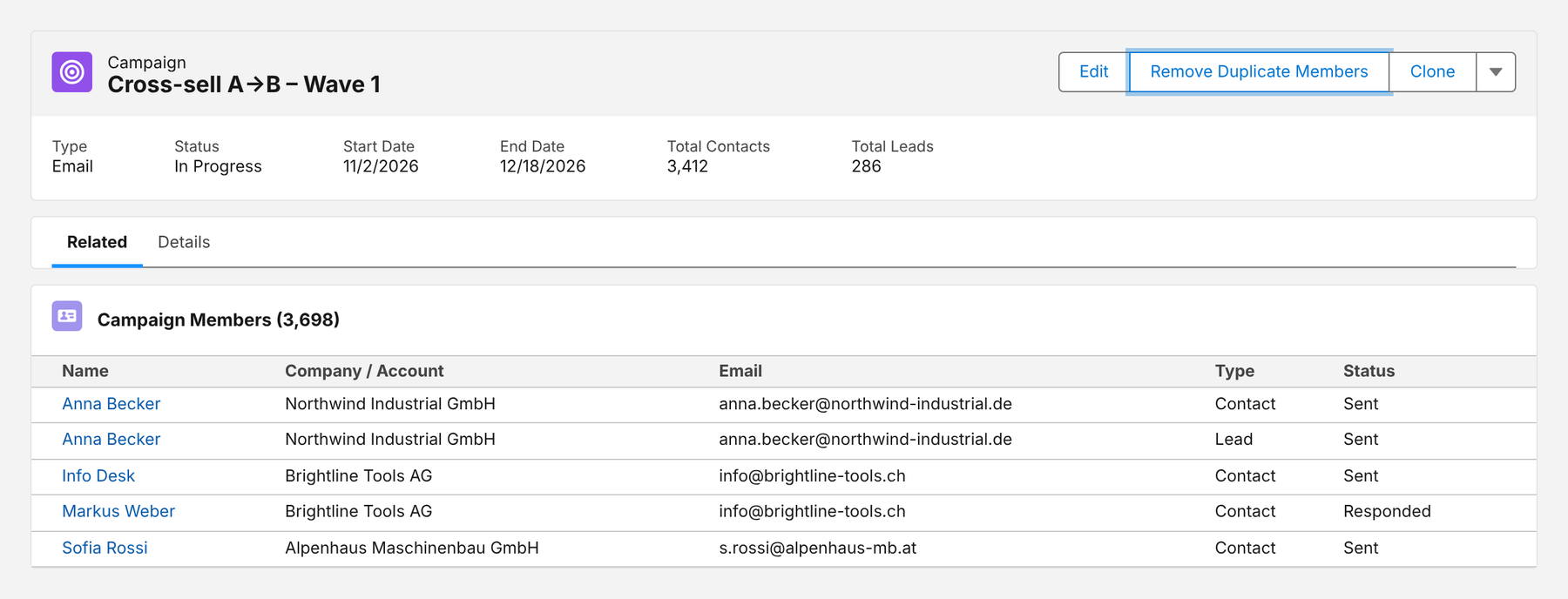
Salesforce doesn’t let you add the same lead or contact to a campaign twice – but it happily adds different records that share the same email address. The result: duplicate sends, duplicate letters and skewed campaign reporting. Salesforce has no built-in way to clean this up at campaign level. Campaign Audience Builder adds a “Remove Duplicate Members” button that deduplicates a campaign by email address in two clicks – included in the free plan.
How duplicate campaign members happen
A campaign member is always tied to exactly one lead or contact, and each record can join a campaign only once. Duplicates therefore come from different records with the same email address:
- Lead and contact: a person exists as a contact, and a new lead with the same email is created by a form or import.
- Shared addresses: several contacts use the same generic address like info@ or office@ – common in small businesses and associations.
- Unmerged duplicates: the same person exists twice as a contact, for example under two accounts.
- Multiple sources: campaign members come from several reports, imports or audiences that overlap.
Why duplicates matter
“The marketing tool will sort it out” – sometimes. But duplicates on the campaign cause real problems:
- Send List Email: Salesforce’s own list email sends one email per campaign member. Three members with the same address mean three identical emails in one inbox.
- Print and offline campaigns: letters, catalogs, postcards and gifts are produced and shipped per member – duplicates cost real money.
- Event planning: invitation and attendee lists with duplicates distort capacity planning.
- Campaign reporting: imagine an event invitation sent via Account Engagement (Pardot) with Accept/Decline buttons that update the campaign member status. If three contacts share the email address, only one member gets the status update – the other two look like non-responders, and your response rate is wrong.
Don’t Account Engagement and Marketing Cloud deduplicate?
Marketing automation tools typically make sure an email address receives a send only once. That protects your recipients – but it doesn’t clean up Salesforce. The duplicates stay on the campaign and keep distorting everything that’s based on campaign members: list emails, exports, print lists and reporting.
Record deduplication vs. campaign member deduplication
When people search for “dedupe Salesforce”, they usually mean record deduplication – finding and merging duplicate leads, contacts and accounts. Salesforce offers:
- Matching rules and duplicate rules that warn or block when users create likely duplicates,
- Merge for up to three leads, contacts or accounts at once,
- Duplicate jobs to scan existing data (in Performance and Unlimited Edition),
- and a range of AppExchange dedupe tools for large-scale clean-ups.
That’s important data hygiene – but it doesn’t solve the campaign problem. Many records sharing an email address are legitimate: a lead and a contact for the same person during a sales process, or several real people behind info@. You don’t want to merge them; you just don’t want them on the same campaign twice.
Campaign member deduplication therefore works one level higher: it leaves the records alone and makes sure each email address appears only once in a specific campaign.
What is a deduplicated audience?
A deduplicated audience is a target group in which every person – usually identified by email address – appears exactly once, no matter how many records exist for them. In Salesforce, that means a campaign without members sharing the same email. It’s the basis for clean sends, correct costs for physical mailings and reliable response rates.
Removing duplicates natively
Without additional tools, cleaning up a campaign is a manual process:
- Create a campaign member report for the campaign, grouped by email address.
- Identify groups with more than one member.
- Remove the extra members by hand on the campaign, or export their IDs and delete them with Data Loader.
It works – but it’s tedious, easy to get wrong, and has to be repeated whenever members are added.
Removing duplicate campaign members with Campaign Audience Builder
Because Salesforce doesn’t offer deduplication at campaign level, we built it into Campaign Audience Builder – and made it part of the free plan, so every Salesforce org can use it.
Which problems it solves
| Known problem | How Campaign Audience Builder solves it |
|---|---|
| Salesforce can’t deduplicate campaign members | “Remove Duplicate Members” button directly on the campaign |
| Report-and-delete is manual and error-prone | Duplicates by email address are identified automatically |
| You need control over which record stays | Automatic mode keeps the oldest member – or pick manually |
| Legitimate records shouldn’t be merged | Only campaign members are removed; leads and contacts stay untouched |
| Data hygiene tools cost extra | Included in the free plan |
Step by step
1. Add the button. Add the “Remove Duplicate Members” button to your campaign page layout – a one-time setup described in our documentation.
2. Open the deduplication. On the campaign, click “Remove Duplicate Members”.
3. Choose automatic or manual.
- Automatic: for every email address, the oldest campaign member (by creation date) is kept, all others are removed.
- Manual: you see every group of duplicates and select which members to remove – useful if, for example, the contact should win over the lead.
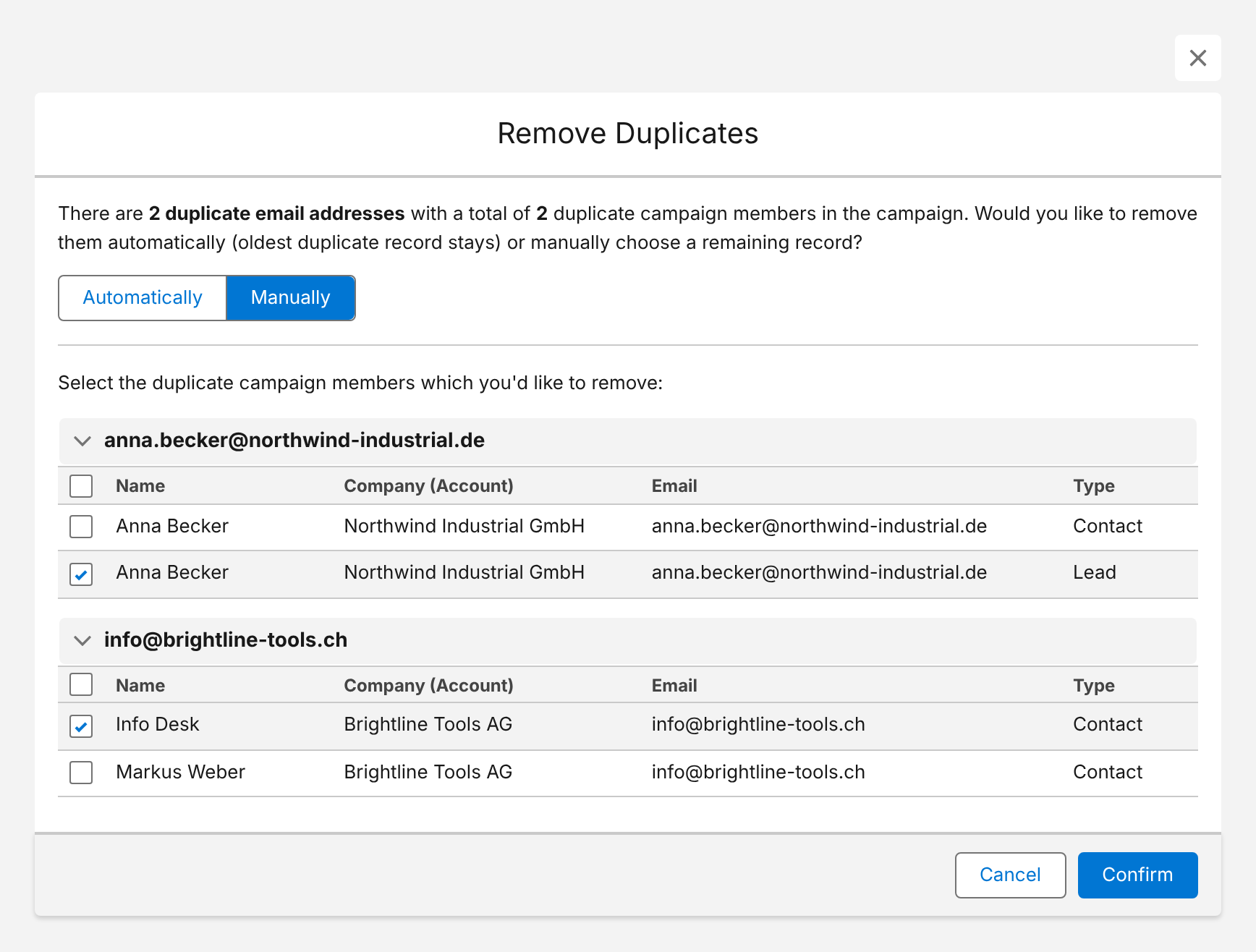
4. Confirm. The duplicates are removed from the campaign – the leads and contacts themselves stay untouched.
With the automatic option, it’s literally two clicks: Remove Duplicate Members → Confirm.
Best practices
- Deduplicate before every send – especially before list emails, print mailings and event invitations.
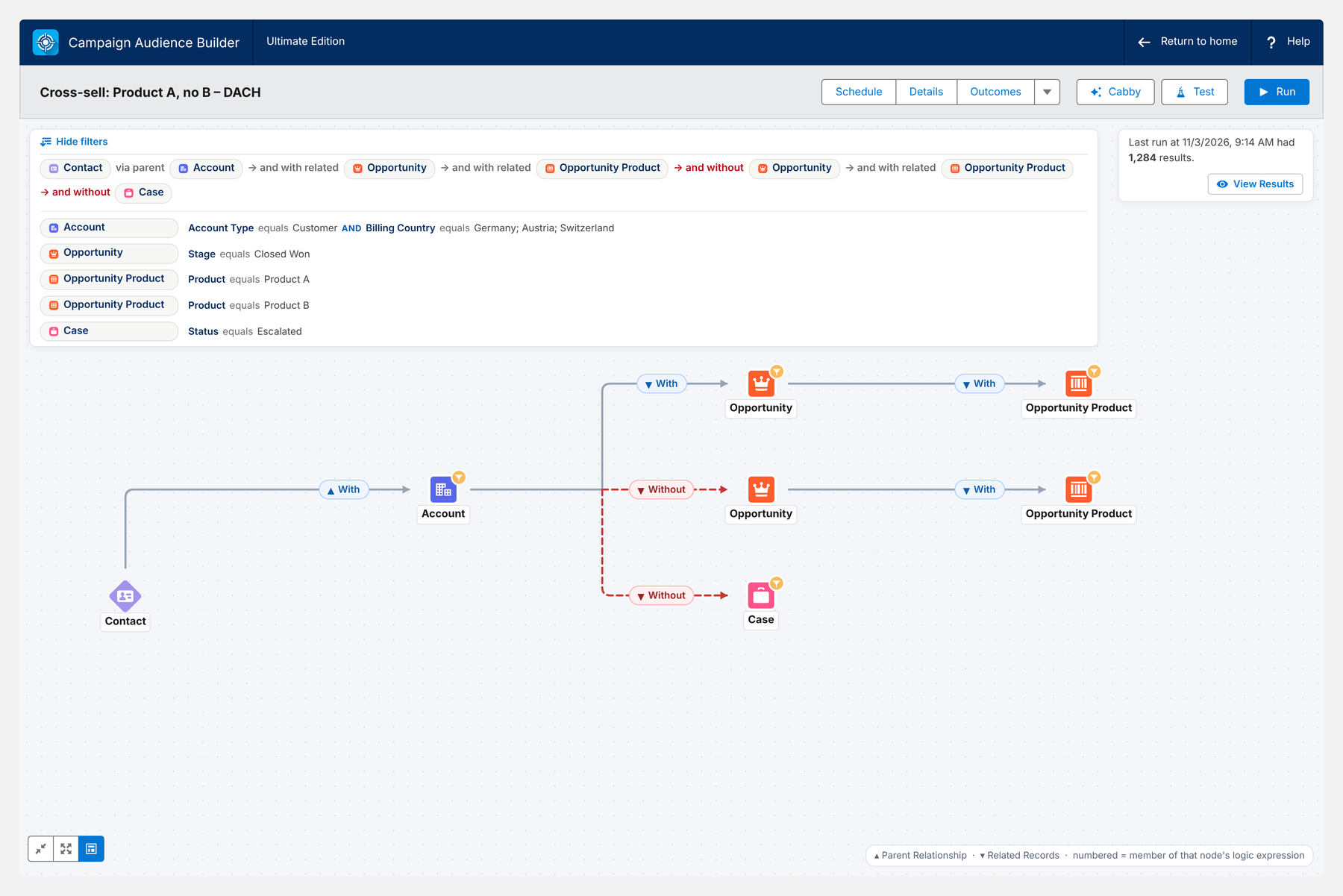
- Combine it with automated audiences. Let audiences fill and refresh your campaigns, then remove duplicates before the campaign goes out.
- Decide which record should win. If contacts should always take precedence over leads, use the manual option or exclude leads with an existing contact in your audience criteria.
- Keep record deduplication as a separate process. Matching rules, duplicate rules and regular merges reduce the number of duplicates that can end up in campaigns in the first place.
Conclusion
Duplicate campaign members aren’t a sign of bad data – they’re the normal result of leads, contacts and shared addresses living side by side. But on a campaign, they lead to double sends, wasted print budget and wrong response rates.
Salesforce doesn’t offer a fix at campaign level. Campaign Audience Builder does: one button, automatic or manual, and every email address appears only once – free for every Salesforce org.
 Campaign Audience Builder
Keep campaigns free of duplicates – before and after
Campaign Audience Builder removes duplicates at both ends – among members already in a campaign, and in the audience before it reaches the campaign.
- Remove duplicate campaign members
- One record per person or household
- Add 50,000+ campaign members in one run
FAQ
Can the same contact be added to a Salesforce campaign twice?
No. A lead or contact can only be a member of a campaign once. Duplicate campaign members are always different records – for example a lead and a contact, or several contacts – that share the same email address.
Does Salesforce deduplicate campaign members automatically?
No. Duplicate and matching rules help prevent duplicate leads, contacts and accounts, but Salesforce has no built-in function that removes campaign members sharing an email address. You need a report-and-delete process or a tool like Campaign Audience Builder.
What is a deduplicated audience?
A deduplicated audience is a target group in which every person – usually identified by email address – appears only once, even if your database holds several records for them. It prevents double sends, double print mailings and distorted response rates.
Don't Account Engagement and Marketing Cloud handle duplicates anyway?
Marketing automation tools typically make sure an email address receives a send only once. But the duplicates remain on the Salesforce campaign, which affects Send List Email, print and event lists, and campaign reporting – for example when only one of several members gets the response status.
Which campaign member is kept when duplicates are removed?
With Campaign Audience Builder's automatic option, the oldest campaign member per email address (by creation date) is kept and the others are removed. With the manual option, you choose yourself which members to remove.